
Technical Whitepaper — Protocol Specification & Architecture
Reference Implementation: superlexicon-app (Rust / Embive / Dual-Band FLRC)
Document Version: 2.4 (September 2026)
Abstract #
Contemporary blockchain architectures (e.g., Ethereum Gasper [12], Solana Tower BFT [58], Cosmos Tendermint [8]) fundamentally presume the ubiquitous availability of the global Internet: high-bandwidth, full-duplex fiber-optic backbones, physical Ethernet switches, cloud hypervisors, and the OS-level TCP/IP networking stack. When physical telecommunications infrastructure fails—due to catastrophic natural disasters, kinetic conflict, regional power grid collapse, or state-level ISP firewall blackouts—these protocols immediately grind to a halt.
SuperLexicon introduces a Distributed Synchronized-by-Radio State Machine (DSR-SM) architecture. Unlike traditional distributed state machines that rely on cloud-tethered TCP/IP sockets and centralized Network Time Protocol (NTP) servers, and unlike ad-hoc wireless mesh overlays that act merely as uncoordinated best-effort message relays without a replicated state machine, SuperLexicon synchronizes atomic state transitions, virtual token ring time slots, cryptographic block heights, and Byzantine consensus directly over raw over-the-air radio frequency (RF) broadcasts. By shedding all dependence on the TCP/IP stack, physical switches, routers, and centralized servers, SuperLexicon executes deterministic state transitions directly over half-duplex, low-power sub-GHz and 2.4 GHz radio transceivers (such as hardware dual-band FLRC transceivers [50]).
At the core of the protocol is a Time-Slotted 4-Phase (8-Step) Consensus Engine governed by an absolute Unix-millisecond clock grid. SuperLexicon replaces conventional multi-round request-response gossip with a deterministic virtual token ring, full-mempool dissemination under canonical gas caps, strict same-window mention elections, post-tabulation sequential execution, and signed root-matching quorum certificates. Crucially, SuperLexicon is a completely free blockchain that imposes zero gas or transaction fees; it proves that economically incentivized consensus is not the only solution to spam control, maintaining resilience through an adaptive, self-tuning Dynamic Probation mechanism. Coupled with an out-of-band content-addressed bytecode system and an isolated bare-metal Embive RISC-V smart contract sandbox, SuperLexicon delivers an unyielding, delay-tolerant [15], Byzantine fault-tolerant [14], [20] computational utility that thrives in the dark.
1. Motivation & Physical-Layer Threat Model #
1.1 The Fragility of Contemporary Web3 #
All prominent distributed ledger technologies advertise decentralization at the algorithmic layer while remaining completely centralized at the physical transport layer, inheriting assumptions of ubiquitous high-speed Internet backbones established since early distributed protocols [40], [57]:
- Unicast Stream Serialization: Standard peer-to-peer (P2P) libraries (e.g.,
libp2p[48],devp2p) establish point-to-point TCP/QUIC streams [47]. When node $A$ gossips a 100 KB block proposal to 50 peers, it must serialize and transmit those 100 KB fifty individual times across switched interfaces. - TCP/IP Stack Overhead: Every consensus frame is wrapped in transport and network layer headers, subjected to three-way handshakes, sequence tracking, flow-control sliding windows, and IP routing table lookups.
- Infrastructure Dependency: Nodes universally rely on ISP routing, Border Gateway Protocol (BGP [49]), Domain Name Systems (DNS [39]), and commercial data centers (AWS, Hetzner, Equinix).
Traditional Blockchain Gossip (Point-to-Point Unicast):
Node A ────(TCP Unicast 1)────► Node B (via ISP / Cloud Switch)
Node A ────(TCP Unicast 2)────► Node C (via ISP / Cloud Switch)
Node A ────(TCP Unicast 3)────► Node D (via ISP / Cloud Switch)
* Failure of switch, router, or ISP halts consensus.

SuperLexicon P2MP Physical Radio Broadcast:
                  ┌─► Node B (Over-The-Air, raw RF frame)
Node A ──(RF PHY)─┼─► Node C (Over-The-Air, raw RF frame)
                  └─► Node D (Over-The-Air, raw RF frame)
* One single over-the-air transmission reaches all peers in radius simultaneously.
* Zero switches, zero routers, zero ISP gateways, zero TCP/IP stack.
1.2 The Threat Model: Sovereign Ledger Continuity #
SuperLexicon is engineered to guarantee Byzantine ledger continuity across severe physical failure domains:
- National ISP Kill-Switches: Authoritarian regimes executing deep packet inspection (DPI) or cutting national transit hubs [1] cannot observe or throttle raw radio frames lacking IP headers.
- Kinetic & Natural Disasters: Severed undersea cables, destroyed cellular towers, and regional electrical blackouts leave battery- and solar-powered SuperLexicon nodes intact, establishing ad-hoc wireless consensus meshes.
- RF Jamming & Spectral Contention: By operating across agile frequency bands (915 MHz Sub-GHz and 2.4 GHz FLRC) with localized subnet containment, consensus survives high packet-loss environments without cascade stalls [30], [53].
1.3 The Zero-Fee Paradigm: Multi-Tiered Non-Monetary Spam Control #
A foundational dogma of modern blockchain theory is that financial transaction fees (gas auctions, priority tips, burn mechanisms like EIP-1559 [10]) are the only viable defense against Denial-of-Service (DoS) and Sybil spam attacks [19]. This dogma imposes severe systemic distortions:
- The Failure of Monetary Gas in Adversarial Domains: In crisis scenarios—telecommunications grid collapse, currency hyperinflation, kinetic conflict, or sovereign humanitarian emergencies—ordinary citizens and localized field operators do not possess liquid exchange tokens or fiat-pegged stablecoins to bid in priority fee auctions.
- Economic Centralization & MEV Exploitation: Fee markets concentrate transactional power among well-capitalized arbitrageurs and block proposers who extract Maximal Extractable Value (MEV) [17], systematically pricing out legitimate utility traffic.
SuperLexicon is a Fee-Free Blockchain:
SuperLexicon does not charge users or smart contracts gas or transaction fees. It is engineered as a public, sovereign computational utility.
Crucially, economically incentivized consensus is not the only solution to spam control. SuperLexicon achieves robust, mathematical spam resilience through an integrated multi-tiered physical and architectural defense:
1.3.1 Radio & Proximity Transport: A Natural Physical Wall Against DDoS and Penetration Attacks #
In traditional Internet/TCP-IP networks, any validator node exposed to the public Internet is fundamentally vulnerable to distributed denial-of-service (DDoS) and remote penetration attacks. An attacker renting compromised botnets from offshore data centers thousands of miles away can flood target nodes with gigabits of SYN floods, UDP packet amplification, socket exhaustion, or automated port-scanning penetration probes at virtually zero marginal cost.
SuperLexicon eliminates this entire threat surface through the laws of physics and physical transport isolation:
- Extinction of the Internet Attack Surface: SuperLexicon validators possess no IP addresses, expose no open TCP/UDP ports, resolve no DNS records, and connect to no cloud routers or internet switches. The raw radio frequency (RF) physical transport layer is completely unaddressable from the public Internet. Remote botnets (e.g., Mirai [2]), cloud-based stressers, and automated penetration toolkits cannot route or transmit a single byte into a SuperLexicon subnet.
- The Inverse-Square Physical Barrier: Radio wave propagation is bound by the Friis transmission equation [25] and the inverse-square law ($P_r \propto 1/d^2$). A node can communicate only if it is in direct physical proximity ($\approx 500\ \text{m}$ radius under low-power transmission) to the target subnet's radio mesh. To launch an attack against a SuperLexicon subnet, the adversary cannot hide behind VPNs, TOR proxies [18], or remote proxy providers—they must be physically present on-site with physical RF transceivers, instantly surrendering remote anonymity and exposing their physical presence to directional RF signal triangulation.
- Geographical Attack Containment: If an adversary attempts to attack multiple subnets across a metropolitan area, region, or the globe, they face an insurmountable physical barrier: they must physically manufacture, deploy, and maintain radio hardware within line-of-sight of every individual subnet. Even if an attacker activates high-powered RF jamming against one localized subnet, adjacent subnets operate on orthogonal frequency bands and remain completely unaffected.
1.3.2 Consensus-Layer Fortification: Why the 4-Phase Protocol Makes the Physical Wall Impregnable #
The physical proximity wall is only the initial layer of defense; it is made exponentially more secure by SuperLexicon's unique time-slotted 4-phase consensus protocol, which mathematically neutralizes any adversary who attempts an on-site radio flood:
- The 1-Node-Per-User Topology: Because SuperLexicon nodes are ultra-lightweight, low-power edge units ($16-158\ \text{mW}$ transceiver on a Nordic nRF54L15 MCU [42] coupled to a host or edge device), each user can and does operate their own node, submitting transactions directly via their own radio link rather than relying on shared centralized RPC gateways.
- Strict Node-Level Fair-Share Gas Allocation: In every consensus window, the total block computational gas cap ($G_{\text{total}} = 34\text{M}$ computational gas) is partitioned into equal, fair quotas across all active nodes [7]:
where $N$ is the count of active nodes in the subnet. Even if an on-site attacker generates 100,000 spam transactions locally and floods their local airtime, the Phase 2 Byzantine mention election algorithm admits transactions from that node only up to its strict fair-share quota $G_{\text{node}}$. The remainder of the block gas capacity is strictly preserved for honest peers, making it mathematically impossible for an attacker to monopolize or starve the block.
- Zero-Weight Candidate Probation: An adversary attempting to spin up rogue Sybil nodes in proximity cannot hijack voting or stall block finalization. Newly detected nodes are placed in a probationary observation state (
ValidatorStatus::Candidate), where their voting weight is strictly zero ($0 \times (N - f)$). They receive no Phase 1 dissemination gas allocation and their signatures do not count toward Byzantine quorum thresholds [14], [36]. - Instant Relegation upon Protocol Malice: If an on-site node transmits out-of-phase frames, broadcasts conflicting state roots, or attempts to jam Phase 2/3 voting slots, the consensus engine immediately zeroes out its promotion counter and permanently demotes the node to a passive RX-only listener.
- Per-Sender Monotonic Nonce Serialization: Transactions are strictly serialized by sender account nonces [35], [57]. An adversary cannot flood the mempool with out-of-order calls, as any sequence gap immediately halts execution for that sender at the gap without consuming validator compute cycles or polluting the ledger.
1.3.3 Gross Mesh Product (GMP) Tokenomics: Productive GDP Backing vs. Speculative Hype #
Traditional blockchain tokenomics (e.g., Helium, Filecoin, and arbitrary L1/L2 tokens) universally suffer from a structural economic flaw: price valuation is driven almost entirely by the speculative expectation of future use rather than real economic output ($Q$).
- The Speculative Hyper-Inflation Trap: Legacy protocols print unbacked inflationary block rewards out of thin air to subsidize node operators. When speculative interest wanes, miners immediately dump printed tokens onto secondary markets, triggering an inflationary death spiral, node abandonment, and liquidity collapse.
- The Quantity Theory of Money Failure ($M \cdot V = P \cdot Q$): Conventional tokenomics inflate token velocity ($V$) through speculative exchange trading while real economic output ($Q$) remains near zero. The token price is dictated by Greater Fool speculation rather than productive utility.
SuperLexicon's Solution: Gross Mesh Product (GMP) Tokenomics Engine:
SuperLexicon discards unbacked block printing and anchors token issuance strictly to Gross Mesh Product (GMP)—the real economic and physical output generated across the network:
- Physical Capital GDP (Hardware Revenue Engine): Token allocations ($SLXR$) are anchored to real physical hardware manufacturing and device sales ($1\ \text{USD} = 5,000\ \$SLXR$). Every token issued to early adopters is backed by physical balance-sheet capital, terminal deployment, and active node expansion.
- Productive Application GDP (Ecosystem Grants): Token rewards are allocated to developers who build peer-reviewed, open-source smart contracts on the Embive RISC-V and Wasmtime runtimes (CLOB DEX matching, tactical emergency dispatch, DePIN sensor oracle markets). Grants are awarded based on verified transaction throughput ($Q$) rather than speculative promises.
- The 1-Year Incubation Bridge: By locking reward tokens for 1 year before attaching to the MEV-Proof Discrete Time Central Limit Orderbook (CLOB) smart contract on Ethereum Mainnet, SuperLexicon allows real physical GDP and mesh density to compound, insulating token valuation from short-term speculative dumping.
2. Physical & Data-Link Layer Architecture (PHY/MAC) #
2.1 Hardware Architecture Pipeline #
A SuperLexicon physical validator decouples consensus computation from radio frequency modulation through a dedicated microcontroller unit (MCU) bridge:
┌────────────────────────────────────────────────────────────────────────┐
│                        SUPERLEXICON VALIDATOR NODE                     │
│                                                                        │
│  ┌──────────────────────────────────────────────────────────────────┐  │
│  │                     Host Processor (Linux / macOS)               │  │
│  │                                                                  │  │
│  │  ┌────────────────────────┐         ┌─────────────────────────┐  │  │
│  │  │   Consensus Engine     │         │   Embive RISC-V VM      │  │  │
│  │  │  (8-Step Timed Window) │         │ (State Transitions)     │  │  │
│  │  └───────────┬────────────┘         └────────────▲────────────┘  │  │
│  │              │                                   │               │  │
│  │  ┌───────────▼───────────────────────────────────┴────────────┐  │  │
│  │  │          TransportRouter & FlrcTransport Backend           │  │  │
│  │  │  - FIFO Deadline Queue (RadioFrame { bytes, deadline })    │  │  │
│  │  │  - Zstandard Compression [16](#ref-16) & Chunking Engine (≤500B / ≤600B) │  │  │
│  │  └───────────────────────────┬────────────────────────────────┘  │  │
│  └──────────────────────────────┼───────────────────────────────────┘  │
│                                 │ USB CDC Serial Link [55](#ref-55)                  │
│                                 │ (1,000,000 baud, 8N1)                │
│  ┌──────────────────────────────▼───────────────────────────────────┐  │
│  │                Dedicated Radio MCU (Nordic nRF54L15 [42](#ref-42))             │  │
│  │  - Raw UART framing parser ('T', 'R', 'C', 'G', 'E')             │  │
│  │  - Burst Radio State Machine (USP / Zephyr RTOS [52](#ref-52))                 │  │
│  │  - 2-deep TX in-flight pipeline window                           │  │
│  └──────────────────────────────┬───────────────────────────────────┘  │
│                                 │ High-Speed SPI Control               │
│  ┌──────────────────────────────▼───────────────────────────────────┐  │
│  │               Dual-Band FLRC Radio Transceiver Front-End [50](#ref-50)         │  │
│  │  - FLRC Modem (Fast Long Range Communication)                    │  │
│  │  - Dual RF Path: 2.4 GHz Local Ring & 915 MHz Sub-GHz Mesh       │  │
│  │  - Sync Word: 0x534C2021 ("SL !") | Bandwidth: 1.2 MHz           │  │
│  └──────────────────────────────┬───────────────────────────────────┘  │
└─────────────────────────────────┼──────────────────────────────────────┘
                                  ▼ Over-The-Air RF Wave
                      [ 1-to-Many P2MP Broadcast ]
2.2 Host-to-MCU Binary Framing #
Communication across the USB CDC serial bridge completely bypasses OS network sockets. The driver (src/flrc_transport/radio.rs) exchanges raw binary frames:
| Frame Type | Tag | Direction | Payload Anatomy | Description |
|---|---|---|---|---|
MSG_CONFIG | 0x43 ('C') | Host $\to$ MCU | [freq: u32 LE][bw: u32 LE][cr: u8][tx_pwr: u8][sync: u32 LE] | Configures modem frequency (915 MHz), bandwidth (1.2 MHz), coding rate, output power (22 dBm), and sync word (0x534C2021). |
MSG_READY | 0x47 ('G') | MCU $\to$ Host | [max_payload: u16 LE] | Acknowledges modem initialization or confirms transmission completion of an in-flight frame. |
MSG_TX | 0x54 ('T') | Host $\to$ MCU | [0x58 'X'][len: u16 LE][payload: len bytes] | 2-byte "TX" header commanding instantaneous RF modulation of payload. |
MSG_RX | 0x52 ('R') | MCU $\to$ Host | [len: u16 LE][payload: len bytes][rssi: i16 LE] | Demodulated over-the-air frame with received signal strength indicator (RSSI). |
MSG_ERROR | 0x45 ('E') | MCU $\to$ Host | [code: u8][msg_len: u8][msg: ASCII] | Hardware fault report or modem timeout. |
MSG_STATS | 0x53 ('S') | MCU $\to$ Host | [len: u16 LE][telemetry] | Periodic 10-second hardware telemetry (packet counts, noise floor). |
2.3 Over-The-Air Wire Protocol (SLRF) #
The physical air interface encapsulates all consensus traffic under a strict magic envelope:
App-Layer Consensus Message Types: #
MSG_TYPE_MEMPOOL (0x01): Mempool transaction broadcast.MSG_TYPE_PROPOSAL (0x02): Legacy single-phase proposal.MSG_TYPE_RECEIPTS (0x03): Post-finality transaction receipts.MSG_TYPE_FINAL (0x04): Finalized block notification.MSG_TYPE_MULTI_PROPOSAL (0x05): Multi-height proposal announcement.MSG_TYPE_TX_BATCH (0x06): Batched transaction payloads.MSG_TYPE_PHASE2_PROPOSAL (0x07): Phase 2 selection vote (VoteRefshash set).MSG_TYPE_BLOCK_BROADCAST (0x08): Phase 4 certified final block broadcast.MSG_TYPE_VOTE_CHUNK (0x09): Chunked phase 2 vote fragment ($\le 500$ bytes).MSG_TYPE_BLOCK_CHUNK (0x0A): Chunked final block fragment ($\le 600$ bytes).MSG_TYPE_BLOCK_PROPOSAL (0x0B): Phase 3 executed block proposal exchange.MSG_TYPE_SUBNET_ADV (0x0D / 13): Subnet discovery advertisement broadcast across radio and UDP interfaces carrying{ subnet_id, connected_subnets, ip_endpoints, tip_height, seq }.MSG_TYPE_SUBNET_TXN (0x0E / 14): Subnet routed transaction envelope carrying{ origin_subnet, target_subnet, raw_tx_hex (RLP [57]), hops_left }. Relayed unparsed until executed strictly by the destination subnet.MSG_TYPE_SUBNET_BLOCK (0x0F / 15): Subnet routed finalized block relay carrying{ origin_subnet, block_height, block_hash_hex, hops_left, payload (bincode BlockBroadcastMessage) }. Relays confirmed blocks to origin subnets for receipt verification.
2.4 Half-Duplex Transmission Discipline #
Because standard RF transceivers are half-duplex (incapable of simultaneous transmission and reception on the same frequency band), uncoordinated broadcasts lead to destructive RF packet collisions and exponential throughput collapse [26]. SuperLexicon implements three strict PHY/MAC disciplines [33]:
- Strict Deadline-Enforced Single FIFO Lane:
Outbound packets are enqueued as RadioFrame { bytes, deadline_unix_ms }. The radio driver measures true serial handoff and air pacing ($\approx 46\ \mu\text{s}/\text{byte}$). If a frame's computed transmission completion would exceed its phase boundary (deadline_unix_ms), the frame is dropped immediately rather than polluting the airspace of the subsequent phase.
- RF Packet Splitting & Chunk Caps:
Empirical testing over marginal radio links establishes a steep packet-delivery drop-off: 2-packet bursts deliver with $>99\%$ reliability, whereas monolithic 22-packet bursts ($5.4\ \text{KB}$) experience near-total assembly failure. SuperLexicon caps vote frames at $500\ \text{bytes}$ (MAX_VOTE_CHUNK_BYTES) and block broadcasts at $600\ \text{bytes}$ (MAX_BLOCK_CHUNK_BYTES).
- Interframe Delay & Successor Spacing:
To prevent receiver buffer overrun, transmissions enforce a hardware interframe delay floor of $1200\ \mu\text{s}$ (min_interframe_delay_us), ensuring pacing exceeds MCU polling granularity. Virtual token ring slots enforce a $250\ \text{ms}$ burst-cycle successor gap to allow complete RF energy decay before the next node transmits.
2.5 Advanced RF Topologies: Multi-Antenna Broadcasting & Coordinated Frequency Hopping #
To guarantee uninterrupted physical-layer survivability under aggressive RF jamming, high noise floors, or dense multi-path fading, SuperLexicon's physical transport roadmap specifies:
- Multi-Antenna Simultaneous Broadcasting (MIMO / Array Beamforming): Nodes can drive multi-transceiver front-ends simultaneously [45], overcoming Rayleigh multi-path fading [30]. By transmitting correlated spatial streams across diverse antenna polarizations and beam angles, nodes achieve spatial diversity gains, multiply effective radiated power (ERP), and provide dynamic spatial nulling against directional RF interference.
- Coordinated Frequency-Hopping Spread Spectrum (FHSS): Rather than remaining statically on a single frequency (e.g., 915 MHz or 2.4 GHz), transceivers synchronize pseudorandom frequency hopping directly against the absolute Unix-epoch millisecond grid ($W_i \parallel \text{slot}$) [53]. Transceivers hop across dozens of sub-GHz channels in lockstep, rendering intentional jamming and narrowband interference ineffective without requiring centralized frequency coordination.
2.6 Physical-Layer Scaling: Half-Duplex Development Baseline vs. Production 2x2 MIMO Dual-Band Architecture #
All existing testnet telemetry, phase boundaries, and empirical metrics presented in this specification reflect the conservative operational bounds of the first-generation development prototype—a single-transceiver, half-duplex radio front-end (Semtech SX1280 / Nordic nRF54L15) subjected to strict time-division multiplexing, non-overlapping phase slots, and an empirical $1200\ \mu\text{s}$ turnaround deadtime floor. The production hardware roadmap specifies a Dual-Band $2 \times 2$ MIMO Concurrent Transceiver Architecture (simultaneous Sub-GHz 868/915 MHz long-range mesh and 2.4 GHz FLRC high-speed consensus). Below, we derive the theoretical and architectural scaling metrics achieved by this transition.
1. Shannon-Hartley Spectral Efficiency & Bitrate Doubling #
Under a Single-Input Single-Output (SISO) half-duplex link with channel bandwidth $B = 1.2\ \text{MHz}$ and operational signal-to-noise ratio $\text{SNR} \approx 15\ \text{dB}$ ($\approx 31.62$ linear), the theoretical Shannon capacity is bounded by:
In practice, FLRC modulation achieves $R_{\text{PHY}} = 1.3\ \text{Mbps}$ raw uncoded physical bitrate ($R_{\text{eff}} \approx 650\ \text{kbps}$ to $975\ \text{kbps}$ with convolutional FEC rate $1/2$ or $3/4$).
Under a production $2 \times 2$ MIMO architecture with two spatially decorrelated antenna elements and two independent RF chains operating over rich-scattering tactical/urban multipath environments, the capacity expands as the sum of the spatial eigenmodes:
By employing spatial multiplexing, the physical uncoded throughput on the 2.4 GHz FLRC link doubles from $1.3\ \text{Mbps}$ to $2.6\ \text{Mbps}$ over the exact same $1.2\ \text{MHz}$ spectral allocation. Alternatively, when operating under extreme path loss, switching to Maximum Ratio Combining (MRC) diversity beamforming provides $+3\ \text{dB}$ to $+6\ \text{dB}$ of array link margin, reducing bit error rates by up to two orders of magnitude and eliminating frame retransmissions.
2. Elimination of Half-Duplex Turnaround Deadtime via Concurrent Dual-Band Full-Duplex Emulation #
In the single-transceiver development baseline, every switch between receive mode (RX) and transmit mode (TX) incurs PLL relock, RF switch settling, and SPI buffer handoff:
Across an 8-node validator ring with 4 phases, turnaround deadtime consumes $\approx 150 - 300\ \text{ms}$ of idle airtime per round.
In the production dual-band architecture:
- Transceiver Chain 1: Dedicated Sub-GHz (868/915 MHz) RF front-end with a quarter-wave whip element ($\lambda/4 \approx 8.2\ \text{cm}$).
- Transceiver Chain 2: Dedicated 2.4 GHz FLRC RF front-end with a compact stub element ($\lambda/4 \approx 3.1\ \text{cm}$).
Because the carrier frequencies are separated by over $1.4\ \text{GHz}$, physical isolation and onboard ceramic bandpass filters provide $>45\ \text{dB}$ of inter-band cross-attenuation. This enables simultaneous full-duplex operation: a node can continuously listen for asynchronous mempool transaction broadcasts on Sub-GHz while concurrently transmitting Phase 2/3/4 consensus bursts on 2.4 GHz without desensing either receiver. Turnaround deadtime is effectively reduced to $0\ \mu\text{s}$.
3. Consensus Phase Pipelining & Window Compression Calculus #
In the half-duplex development prototype, consensus phases are executed strictly serially to prevent on-air collisions:
In the production MIMO dual-band architecture:
- Phase 1 (Pipelined Mempool Dissemination): Operates continuously in the background across the Sub-GHz channel ($0\ \text{ms}$ blocking latency for block $h$). Transactions for block $h+1$ are continuously received and validated while block $h$ is being finalized.
- Phase 2 (Parallel MIMO Selection Voting): With a $2.6\ \text{Mbps}$ physical transmission rate, a $500\ \text{byte}$ vote packet transmits in $T_{\text{air}} \approx 1.54\ \text{ms}$ (down from $3.08\ \text{ms}$). Allocating dedicated spatial slots across active validators compresses the entire selection phase to $200 - 300\ \text{ms}$.
- Phase 3 (Proposal & Deterministic Execution): Canonical sorting
SortBy(sender, nonce)and bare-metal Embive RV32I execution consumes $\approx 1.6\ \text{ms}$ on low-power RISC-V silicon ($<0.4\ \text{ms}$ on host/SLX3). Disseminating block proposals over $2.6\ \text{Mbps}$ FLRC consumes $300 - 450\ \text{ms}$. - Phase 4 (Quorum Certificate & Final Broadcast): Aggregated threshold signatures and certified block headers broadcast across parallel spatial streams in $150 - 250\ \text{ms}$.
Calculated Production Consensus Window:
This represents an $\approx 5\times$ to $7.5\times$ reduction in block time compared to the $6.0\ \text{s}$ dev profile, and a $15\times$ reduction compared to the conservative $18\ \text{s}$ multi-hop profile.
4. Throughput Scaling Derivation #
In the development prototype:
In the production MIMO dual-band architecture, the doubled PHY bitrate ($2.6\ \text{Mbps}$) and pipelined background dissemination allow the block capacity to safely scale from $32\ \text{tx}$ to $64 - 128\ \text{tx}$ per block ($9.6 - 19.2\ \text{KB}$ Zstandard-compressed payload):
This yields a $12\times$ to $20\times$ increase in sustained transaction throughput directly over raw physical airwaves, demonstrating that radio-synchronized state machines can achieve throughput and finality comparable to conventional broadband L1 networks while operating completely off-grid.
3. Consensus Architecture: The Leaderless 4-Phase Protocol & Self-Deterministic Convergence #
3.1 Leaderless Consensus Mechanics: Decentralized State Machine Specification #
Contemporary blockchains almost universally rely on single-leader paradigms (e.g., PBFT [14], Tendermint [8], Raft [43], HotStuff [59], Solana Tower BFT [58], and Ethereum Gasper [12]). In these protocols, a designated rotating leader proposes a block, while the remainder of the network acts as passive voters or attestation witnesses:
- The Structural Flaws of Single-Leader Chains:
- Single Point of Failure & Targeted Attack Vector: The leader is an obvious target for denial-of-service, RF jamming, physical kinetic attack, or targeted censorship.
- Centralized Sequencing & MEV: The leader unilaterally decides transaction ordering, extraction of Maximal Extractable Value (MEV) [17], and front-running.
- Fragile View-Change Protocols: When a leader fails, the network must enter complex, latency-heavy "view-change" rounds. Over half-duplex radio networks with variable packet delivery, view-change protocols reliably cascade into catastrophic deadlocks.
The SuperLexicon Breakthrough: Truly Leaderless & Self-Deterministic:
SuperLexicon completely eliminates the concept of a single leader. Every validator proposes every round. It establishes an asynchronous consensus tabulation and block finalization design pattern where every validator broadcasts to other validators over the shared physical airwaves.
Through a rigorously researched convergence methodology, each node independently self-determines—purely based on the ambient broadcasts received from its peers—whether the network has confirmed and finalized a block of transactions:
- Zero Interactive ACKs: Nodes never send request-response acknowledgements or wait for master confirmations.
- Ambient Cryptographic Proofs: A validator knows a block is permanently finalized the exact instant it observes a Byzantine quorum ($\ge N - f$) [14], [36] of matching proposal signatures covering the identical parent hash, transaction set root, and post-execution state root. The proof is self-contained, deterministic, and identical across every node on the network.
- Leaderless Distributed Specification: By discarding centralized sequencers, rotating leaders, and interactive handshakes, SuperLexicon realizes a self-deterministic, leaderless distributed state machine optimized for low-power wireless mesh networks.
3.2 The Core 4-Phase Consensus Engine #
Consensus advances in wall-clock windows governed by the absolute Unix-epoch millisecond grid ($W_i = \lfloor t_{\text{unix\_ms}} / T_{\text{window}} \rfloor$), ensuring all nodes agree on round boundaries without message coordination.
Dynamic Self-Optimization & Configurable Ranges:
Phase durations and the total consensus round total ($T_{\text{window}}$) are not fixed constants; they are fully configurable and dynamically self-optimized by the network as part of Phase 4 final block broadcasts. As the network operates, Phase 4 frames carry aggregated hardware telemetry, measured air pacing ($\approx 46\ \mu\text{s}/\text{byte}$), and packet loss rates. If the network experiences heavy RF congestion or the validator fleet expands, window parameters dynamically expand to preserve delivery guarantees; conversely, under pristine RF conditions, timings compress to accelerate confirmation latency.
Across deployed profiles, phase durations operate within the following empirical ranges:
- Total Consensus Round ($T_{\text{window}}$): Configurable, typically $6 - 18\ \text{seconds}$ (e.g., $9.9\ \text{s}$, $14\ \text{s}$, and $17\ \text{s}$ operational profiles).
- Phase 1 (Mempool Broadcast): $3,000 - 8,000\ \text{ms}$ (scaled to active validator count $N$ and pending mempool volume).
- Phase 2 (Selection Votes): $800 - 2,500\ \text{ms}$ (scaled across validator TDMA air slots with boundary guard).
- Phase 3 (Proposal Exchange): $800 - 2,500\ \text{ms}$ (allocated for proposal broadcast and certificate formation).
- Phase 4 (Final Block & Self-Optimization): $1,000 - 3,000\ \text{ms}$ (allocated for certified block broadcast, lag healing, and timing self-optimization).
SuperLexicon 4-Phase Consensus Sequence:

  Phase 1: Mempool Broadcast        Phase 2: Selection Votes          Phase 3: Proposal Exchange        Phase 4: Final Block Broadcast
  ┌───────────────────────────┐     ┌───────────────────────────┐     ┌───────────────────────────┐     ┌───────────────────────────┐
  │ Every node airs candidate │ ──► │ Every node airs signed    │ ──► │ Every node airs executed  │ ──► │ Elected broadcaster airs  │
  │ mempool transactions via  │     │ selection votes (4-byte   │     │ proposal committing to    │     │ certified compact block & │
  │ TDMA ring air slots.      │     │ tx refs & set_root).      │     │ state root & set root.    │     │ self-optimizing params.   │
  └───────────────────────────┘     └───────────────────────────┘     └───────────────────────────┘     └───────────────────────────┘
Phase 1: Mempool Dissemination Broadcast (Air: ~3000 – 8000 ms) #
- Primary Purpose: Establishing Global Mempool Convergence and State Dissemination in a purely half-duplex wireless environment without a centralized sequencer or internet backhaul.
- Architectural Necessity:
In conventional blockchains, transactions enter through global RPC endpoints and propagate over high-bandwidth TCP gossip. In an infrastructure-free radio mesh, clients submit transactions locally via near-field RPC to disparate, physically separated nodes (e.g., Node 1 receives transactions 1–10, Node 2 receives 11–20, Node 3 receives 21–30). Without a coordinated broadcast phase, nodes would possess fragmented, non-overlapping mempool views, making consensus impossible. Phase 1 provides the dedicated airtime required to disperse all newly admitted transactions across the entire physical radio propagation radius.
- Protocol Mechanics & Wire Payload:
- P2MP Over-The-Air Radiation: A single RF transmission from a validator reaches every listening peer within line-of-sight and multi-path reflection simultaneously.
- Virtual Token Ring Scheduling: To avoid catastrophic RF packet collisions over half-duplex radios, validators air their pools strictly in order of their lexicographically sorted public keys ($\text{Slot}(V_k) = k \cdot (T_{P1} / N)$).
- Paced Session Framing: Transactions are packed into small, highly reliable chunks ($\le 600\ \text{bytes}$) paced one frame budget apart ($200\ \text{ms}$), stamped with the deadline of Phase 1.
- Gas-Capped Airing: Rather than rationing fractional gas shares, each active node airs its candidate transaction set up to the canonical Block Gas Limit ($34,000,000\ \text{gas}$).
- Invariants & Failure Mitigations:
- Immediate Mempool Ingestion: Radio-received transactions bypass speculative execution buffers and insert directly into the receiving node's active mempool.
- Zero Cross-Phase Pollution: Outbound frames exceeding the Phase 1 wall-clock deadline are dropped by the radio driver's single FIFO lane, guaranteeing that dissemination traffic never bleeds into voting air slots.
Phase 2: Selection Vote Airing (Air: ~800 – 2500 ms) #
- Primary Purpose: Achieving Deterministic Democratic Election of the Transaction Set ("Agreement on Input") across all nodes BEFORE any smart contract execution occurs.
- Architectural Necessity:
Traditional BFT chains often rely on speculative execution, where nodes execute transactions optimistically before voting on the state root. Over half-duplex radio links with transient packet loss, speculative execution creates devastating fork splits: if Node A missed a single transaction that Node B executed, their state roots diverge, causing consensus to stall. Phase 2 eliminates this vulnerability by completely decoupling Transaction Selection from State Execution.
- Protocol Mechanics & Wire Payload:
- Pure Selection Statement: Phase 2 is an explicit agreement on what will be executed. No execution has taken place; there is no state root inside a Phase 2 vote.
- 4-Byte Wire References (
tx_refs): Transmitting 32-byte hashes for every transaction would congest low-bandwidth FLRC airwaves. Phase 2 introduces an intermediary naming scheme: nodes broadcast only the first 4 bytes of each transaction hash. For typical block sizes ($\le 32$ transactions), the collision probability is negligible ($p \approx 1.2 \times 10^{-7}$). - Transaction Set Root (
set_root): The vote binds the selected transactions via a single cryptographic commitment: $\text{Keccak256}$ [41] over the sorted full 32-byte transaction hashes. - Common Signed Payload: The Ed25519 signature [6], [31] binds only the invariant round metadata:
Because the signed preimage is identical for all validators in window $W_i$, votes are cryptographically uniform, and selection fields remain modular.
- Invariants & Failure Mitigations:
- Zero Speculative State Mutation: State tries remain completely untouched during Phase 2.
- Strict Byzantine Tally Rule: As votes arrive, nodes tally mentions for each
tx_ref. A transaction is officially elected into the block candidate set if and only if it achieves the Byzantine quorum threshold ($\ge N - f$ mentions across active validators). - Node-Level Fair Gas Quotas: During transaction subset selection, nodes enforce the fair-share allocation cap ($G_{\text{node}} \le G_{\text{total}} / N$). Any surplus transactions from a single proposing node exceeding its quota are deferred to subsequent windows, guaranteeing that no single node can monopolize the candidate block.
Phase 3: Block Proposal Exchange (Air: ~800 – 2500 ms) #
- Primary Purpose: Generating and exchanging Cryptographic State Transition Proofs ("Agreement on Output") resulting from the sequential execution of the elected transaction set.
- Architectural Necessity:
Having locked the exact block contents through Byzantine mention election in Phase 2, every validator now possesses the identical transaction sequence. Phase 3 allows each node to execute those transactions deterministically against its local state machine and broadcast a signed cryptographic commitment proving that its local state transition bit-for-bit matches its peers.
- Protocol Mechanics & Wire Payload:
- Deterministic Sequential Execution: The elected transaction set is grouped per-sender, sorted in strict ascending account nonce order, and executed deterministically against the state trie [35], [57].
- The Strict Nonce Invariant: If an account has a missing nonce or an unresolvable transaction, execution halts at the gap for that sender. Lower-nonce transactions execute cleanly without being orphaned, while unexecutable transactions remain in the mempool for subsequent windows.
- Post-State Root Generation: Execution output (balance deltas, nonce increments, contract storage key-value changes) is evaluated into a
ContractStateDiffand folded into the deterministicpost_state_root. - Content-Bound Proposal Signature: Each validator broadcasts a signed
BlockProposalExchangeMessagewhere the signature explicitly binds the execution results: - Invariants & Failure Mitigations:
- Equivocation Alarms: If a Byzantine node signs two differing proposals with different roots for the same height, peers immediately detect the duplicate signature on differing preimages and trigger an equivocation alarm.
- Staged State Commits: State transitions remain staged in memory buffers; no state is permanently committed to RocksDB until finalization is proven in Phase 4.
Phase 4: Final Block Broadcast & Dynamic Optimization (Air: ~1000 – 3000 ms) #
- Primary Purpose: Delivering Autonomous Finality Certification, Laggard Self-Healing, and Dynamic Network Timing Optimization.
- Architectural Necessity:
In a broadcast network without a central coordinator or point-to-point TCP ACKs, nodes must independently verify when finality has occurred, recover from transient RF packet dropouts without expensive out-of-band state syncing, and dynamically tune the radio clock grid to shifting physical conditions.
- Protocol Mechanics & Wire Payload:
- Root-Matching Quorum Certification: Nodes tabulate incoming Phase 3 proposals by the tuple $\mathcal{K} = (\text{ParentHash}, \text{set\_root}, \text{post\_state\_root})$. The instant a group accumulates $\ge N - f$ matching proposals, the block is finalized.
- Self-Authenticating Certificate: The matching proposals are the consensus certificate. Because each proposal signature covers the post-state root, the quorum proves that $N - f$ independent physical nodes executed the identical transaction set to the exact same cryptographic state.
- Compact Block Broadcast: The elected broadcaster (lowest validator index at the highest finalized height) airs
BlockBroadcastMessagein compact format: canonical header + ordered transaction hashes + consensus certificate (proposals from all agreeing validators). - Depth-1 Ancestor Embedding: The final block embeds the block header from height $h-1$. If a laggard validator suffered complete RF packet loss during window $W_{i-1}$, it ingests both headers and advances two heights in a single round.
- Self-Healing Divergence Resolution: If a node diverged during execution (e.g., due to a missed transaction in Phase 1), it extracts the winning transaction set from the certificate's
tx_refs, re-executes against $\text{ParentHash}$, verifies that its locally computed root reproduces $\text{post\_state\_root}$, and commits the state. - Dynamic Timing Adaptation: Telemetry embedded in Phase 4 broadcasts allows nodes to evaluate link quality, collision rates, and fleet latency, dynamically scaling subsequent window durations up or down in lockstep.
- Invariants & Failure Mitigations:
- Clean Round Reset: At the expiration of Phase 4, all nodes execute a hard clock reset to $t = 0\ \text{ms}$ of window $W_{i+1}$. A failed round (where no group achieved $N - f$ matching roots) finalizes nowhere, leaving the ledger uncorrupted and ready for an immediate clean retry.
3.3 Implementation Details: The 8-Step Timed Window & Pre-Phase Compute Margins #
While the protocol logically operates across the four phases above, physical radio hardware constraints require strict computational margins. SuperLexicon implements an 8-step timed engine alternating four internal compute steps with the four air steps:
Exemplary Timed Consensus Window (Configurable 8-Step Breakdown):

┌───────────┬────────────────────────────────┬──────────┬────────────────────┬──────────┬────────────────────┬──────────┬────────────────────┐
│  Pre-P1   │             P1 Air             │  Pre-P2  │       P2 Air       │  Pre-P3  │       P3 Air       │  Pre-P4  │       P4 Air       │
│ (Compute) │         (Dissemination)        │ (Compute)│       (Votes)      │ (Compute)│    (Proposals)     │ (Compute)│ (Certified Block & │
│ 50-150 ms │         3000-8000 ms           │100-300 ms│    800-2500 ms     │250-500 ms│    800-2500 ms     │150-400 ms│ Self-Optimization) │
│           │                                │          │                    │          │                    │          │   1000-3000 ms     │
└───────────┴────────────────────────────────┴──────────┴────────────────────┴──────────┴────────────────────┴──────────┴────────────────────┘
  Admission    Full Mempool TDMA Broadcast    Deterministic   Signed Wire-Ref     Strict Tally  Signed Executed-Set Tabulate &   Elected Broadcaster
  Gas-Capped   Ring Pacing: N Slots           Tx Selection    Vote Airing         & Sequential  Proposal Exchange   Finalize on  Airs Certified
  Buffer In    (Lowest PubKey First)          No Execution    (N Slots + Guard)   Execution     (N Slots)           Root Match   Block & Telemetry
The Hold-to-Boundary Discipline: #
- Computational Decoupling: If a fast validator completes vote tabulation and sequential execution in $40\ \text{ms}$, it holds until the configured boundary. Transitions are clock-driven, never completion-driven.
- Elimination of Inter-Phase Interference: Without compute buffers, heterogeneous hardware would cause fast nodes to air Phase 3 proposals while slower nodes were still transmitting Phase 2 votes, triggering cross-phase packet collisions.
- The Step Rationale:
PreP1($\approx 50 - 150\ \text{ms}$): FIFO buffer to mempool admission under the canonical $34\text{M}$ gas cap.PreP2($\approx 100 - 300\ \text{ms}$): Merging radio-received transactions, deterministic selection, signing selection vote.PreP3($\approx 250 - 500\ \text{ms}$): Vote tabulation, strict $N - f$ election tally, deterministic sequential execution, post-state root computation, signing proposal.PreP4($\approx 150 - 400\ \text{ms}$): Proposal tabulation by root hash, certificate generation, self-healing divergence re-execution if a node missed an earlier frame, and dynamic window parameter calculation.
3.4 Dynamic Validator Lifecycle: Onboarding, Probation, & Relegation #
SuperLexicon bootstraps from a fixed initial validator set defined in genesis.json. Beyond genesis, validator membership is managed dynamically through on-chain governance transactions (src/consensus/governance.rs).
Membership modifications are confirmed transactions sent to the dedicated governance system address ("SUPERLEXICON" zero-padded: 0x53555045524c455849434f4e00...). They flow through the standard 4-phase consensus pipeline and deterministically mutate the global validator registry in RocksDB during block execution.
Validator Lifecycle State Machine:

              Candidate Node
                    │
                    ▼  (Governance Tx: JOIN_PROBATION)
         ┌─────────────────────┐
         │      PROBATION      │ ◄──┐ (Demote Tx: DEMOTE_PROBATION)
         │  (Proving Period)   │    │
         └──────────┬──────────┘    │
                    │               │
  Passes streak of  │               │ Fails streak / Link drop
  consecutive good  │               │
  matching proposals│               │
                    ▼               │
         ┌─────────────────────┐    │
         │   FULL VALIDATOR    │ ───┘
         │ (Byzantine Quorum)  │
         └─────────────────────┘
                    │
                    ▼ (Failed probation / Remove Tx)
         ┌─────────────────────┐
         │     RX-ONLY NODE    │
         │  (Passive Listener) │
         └─────────────────────┘
The 2-Step Validator Onboarding Process: #
- Step 1: On-Chain Registration into Probation:
A candidate validator broadcasts a JOIN_PROBATION transaction carrying its 32-byte Ed25519 public key. Once confirmed into a block, the node is registered with status ValidatorStatus::Probation.
- Step 2: The Probation Proving Period:
- Zero Byzantine Weight: Probationary validators broadcast Phase 2 votes and Phase 3 proposals so their peers can monitor their behavior, but their messages never count toward any Byzantine quorum or finalization threshold ($N - f$), and they are allocated no Phase 1 dissemination gas share.
- Proving Consensus Fidelity: The probation node must demonstrate clock synchronization, computational integrity, and physical RF link reliability by continuously broadcasting block proposals that strictly match the network's finalized block root across consecutive windows (
consecutive_good). - Promotion to Full Validator: Once the candidate maintains an unbroken streak of matching proposals meeting the network's configured threshold (
min_good_proposals), aPROMOTE_FULLgovernance transaction is submitted and confirmed. The node transitions toValidatorStatus::Full, receiving full voting weight, finalization rights, and scheduled Phase 1 airtime. - Relegation to RX-Only: If a probationary node fails to match consensus—due to divergent execution, corrupted state, missing slots, or inadequate RF reception—it cannot graduate. It is relegated to a regular RX-only node (a passive listener that reads the chain without participating in consensus) or permanently removed from the registry via
REMOVE.
Validator Demotion & Safety Guard: #
- An active Full validator that becomes degraded or uncorroborated can be demoted back to probation via
DEMOTE_PROBATION. - The Invariant Guard (
MIN_FULL_VALIDATORS): To prevent Byzantine failure or network stalling, any governance transaction that would cause the active validator set to fall below three Full validators is deterministically rejected as a no-op across all nodes.
Dynamic Probation Tuning as Non-Monetary Spam Defense: #
Just as the consensus engine dynamically optimizes phase durations as part of Phase 4 final block broadcasts, the network dynamically adjusts the probationary period parameters from time to time:
- Adaptive Horizon Scaling: The network continuously evaluates mempool queue pressure, unconfirmed transaction ratios, and packet collision statistics. When elevated contention or suspected flooding is detected, the network automatically self-adjusts the probationary threshold—scaling
min_good_proposalsfrom standard benchmarks (e.g., 10 consecutive windows) up to higher proving horizons (e.g., 50+ consecutive windows). - Asymmetric Cost on Adversaries: An attacker attempting to spam or Sybil-attack the network cannot simply spend capital to outbid honest users in a fee auction. The attacker must continuously expend real physical computation and radio frequency transmission bandwidth, strictly matching consensus state over an extended, dynamically expanding observation window—without ever possessing voting or quorum power.
- Instant Relegation: The moment an attacker's node emits a malformed transaction, diverges on execution root, skips a required air slot, or attempts to flood the channel, its consecutive matching counter is instantly zeroed out, and the node is permanently relegated to a passive RX-only listener. This proves that economically incentivized consensus is not the only viable solution to spam control.
3.5 State Pruning: Proof of Latest State #
SuperLexicon's guarantee is **proof of latest state and fault/halt-free
transaction execution**, not proof of history. Each node enforces a
configurable RocksDB size limit (config file or --db-size-limit-mb);
when the limit is violated, the oldest history heights are deleted as
each new block confirms — a pruned_height watermark keeps the process
strictly oldest-first, a recent-window floor preserves parent binding
and the sync horizon, and a hysteresis band with bounded compaction
returns the space to the filesystem. The replicated STATE (accounts,
code, contract storage, nonces, the validator registry) is never
pruned, so a node's ability to validate, execute and finalize is
unaffected no matter how much history it has shed. Nodes more than the
retention window behind join via full-state snapshot sync.
3.6 Subnets: Discovery, Routing & Confirmation Relay #
The protocol scales horizontally through subnets — independent
consensus networks, each identified by a 4-byte id derived from its
genesis. Every subnet advertises its identity and its connected-subnet
list over every configured backhaul (the radio broadcast and IP/UDP
endpoints); receivers build a subnet map and a next-hop routing map
with bounded distance-vector relaxation, so a radio-only subnet behind
an internet-backed intermediate resolves through it. Transactions carry
an optional target subnet: local txns follow the normal path, foreign
txns travel as routed envelopes (never executed in transit), and the
target subnet's finalized blocks relay back along the same routes —
that relay IS the confirmation of a routed transaction. There is no
consensus between subnets: each subnet's ledger is sovereign, and the
cross-subnet layer is pure discovery, routing and delivery.
4. State Management, Deterministic Sequential Execution & Out-of-Band Bytecode #
4.1 Fully Replicated Subnet State #
Rather than burdening low-bandwidth radio channels with cross-shard routing protocols, two-phase commits, or parallel threadpool locking, SuperLexicon operates as a fully replicated subnet:
- Complete Local Replication: Every validator maintains the complete world state (account state, nonces, balances, and contract key-value storage) directly on RocksDB [22], built upon log-structured merge-trees [44]. State commitments utilize Verkle trees [34] with KZG polynomial commitments [32], providing compact proof sizes that fit within low-bandwidth wireless consensus frames unlike traditional Merkle Patricia tries [57].
- Zero Sharding Overhead: Eliminating sharding and parallel threadpool consensus lanes removes complex cross-shard gossip over half-duplex RF links, preserving precious airtime for consensus finalization.
4.2 Deterministic Sequential Execution & The Nonce Invariant #
Execution occurs strictly after vote tabulation (in Step 5: PreP3), never speculatively. Because every validator executes the identical elected transaction set:
- Per-Sender Grouping & Nonce Ordering: Transactions within the elected block are partitioned by sender address and sorted strictly in ascending nonce order.
- The Strict Nonce Invariant: If a gap occurs in a sender's nonce sequence (or an individual transaction fails local resolution), execution for that sender halts at the gap. Lower-nonce transactions are processed cleanly without being orphaned, while unexecutable transactions remain in the mempool for subsequent windows.
- Single Post-State Root: Sequential execution folds state transitions deterministically into a single
post_state_root(and accompanyingContractStateDiff), ensuring bit-exact cryptographic root reproduction across all nodes.
4.3 Out-of-Band Content-Addressed Bytecode #
Embedding multi-kilobyte smart contract bytecode inside radio consensus frames would congest low-bandwidth FLRC airwaves. SuperLexicon establishes an out-of-band bytecode architecture:
Contract Deployment Workflow:
1. Developer submits bytecode via RPC: sl_deployBytecode(raw_bytes)
2. Node stores bytecode in RocksDB indexed by code_hash = Keccak256(raw_bytes)
3. On-chain deployment transaction carries ONLY the 32-byte code_hash:
   Tx { to: None, data: code_hash, ... }
4. If a validator receives a block referencing an unknown code_hash:
   Requests bytecode out-of-band via libp2p (/superlexicon/bytecode-sync/1.0.0) [48](#ref-48) or content-addressed storage [5](#ref-5)
   or secondary backhaul before execution.
5. Global Scalability & The Subnet Mesh: Overcoming the Proximity Paradox #
5.1 The Proximity Paradox: The Absurdity of the Global Roundtrip #
Contemporary communications and decentralized networks suffer from what SuperLexicon terms the Proximity Paradox:
To transmit a digital token, settle a commercial transaction, or exchange a cryptographic message with a human or machine situated three meters away across a table, contemporary systems force the packet through local Wi-Fi/cellular towers, regional ISPs, national Internet Exchange Points (IXPs), centralized cloud data centers (AWS, Cloudflare, Google Cloud), across transoceanic undersea fiber cables, and back.
This architectural absurdity entails severe vulnerabilities:
- Total Fragility: A localized power outage, severed fiber link, backhoe trench incident, or ISP routing failure renders local trade and communication impossible, despite the physical proximity of the counterparties.
- Artificial Latency & Energy Waste: Terajoules of energy and hundreds of milliseconds of roundtrip latency are squandered traversing global routing hierarchies for interactions whose physical radius is measured in meters.
- Pervasive Surveillance & Chokepoint Censorship: Every step of the global routing path presents an inspection and filtering vector for corporate monopolies and state chokepoints.
SuperLexicon eliminates the Proximity Paradox at the physical layer. By broadcasting directly peer-to-multiple-peer (P2MP) over raw radio spectrum, transactions settle locally and instantly between proximate participants without touching a single wire, switch, server, or ISP.
Conventional Architecture (The Proximity Paradox):
[Peer A] ──> [Cell Tower] ──> [ISP] ──> [Global IXP] ──> [Cloud DC] ──> [Undersea Fiber] ──> [ISP] ──> [Peer B]
                                 ▲ Total Infrastructure Dependency ▲

SuperLexicon Architecture (Physical Directness):
[Peer A] ═══════════════════════════ (Direct P2MP Radio RF) ═══════════════════════════> [Peer B]
                                 ▲ Zero Infrastructure Required ▲
5.2 The Scalability Trap of Monolithic Broadcast Networks #
While physical P2MP radio broadcasting solves the Proximity Paradox, attempting to force the entire planet into a single monolithic radio network creates an equally fatal physical constraint:
- Shared-Medium Channel Saturation: On a single RF frequency, physical airtime is finite. As the number of nodes $N$ expands within a single broadcast domain, transaction dissemination, selection voting, block proposal broadcasts, and finalization messages compound channel congestion according to the classical half-duplex collision curve and spatial capacity limits [26]:
- Degradation of Consensus Latency: Expanding a single broadcast network globally forces consensus round durations to expand from seconds to minutes or hours to accommodate thousands of uncoordinated half-duplex transmissions, destroying high-frequency local transaction utility.
True global scalability—and ultimate protocol dominance—cannot be achieved by crowding all participants onto one frequency. It requires autonomous, localized Subnets.
5.3 Global Scalability via Autonomous Subnets ("World Domination") #
SuperLexicon achieves unbounded global scaling through an internetwork of localized, autonomous Subnets:
                              [ Conventional WAN / UDP Gateway Backhaul ]
                                                 │ (When Available)
                        ┌────────────────────────┴────────────────────────┐
                        ▼                                                 ▼
         ┌───────────────────────────┐                     ┌───────────────────────────┐
         │       SUBNET ALPHA        │                     │        SUBNET BETA        │
         │   (4-Byte ID: 0xA1B2)     │                     │    (4-Byte ID: 0xC3D4)    │
         │   Local P2MP Consensus    │                     │   Local P2MP Consensus    │
         │  6-18s Single-Window BFT  │                     │  6-18s Single-Window BFT  │
         └──────────────┬────────────┘                     └─────────────┬─────────────┘
                        │                                                │
                        └────────► [ Dedicated Backhaul RF / UDP ] ◄─────┘
                                   (Distance-Vector Relay Mesh)
(MAX_SUBNET_HOPS = 4)- Independent 4-Byte Subnet Identity: Each subnet is an independent consensus network with its own validator set, chain, block gas limit, and 4-phase grid. A subnet identity is a random 4-byte identifier minted once at bootstrap from OS entropy (all-zero
0x00000000reserved as "no subnet") and persisted in the engine blob store undersubnet_id. Every validator on the same chain shares this identifier across restarts. - Hyper-Local Finality: Local transactions within a neighborhood, municipal district, corporate campus, or tactical operational zone are broadcast, validated, executed, and finalized strictly within the local subnet's 4-phase window ($\approx 6-18\ \text{seconds}$) at zero transaction fees. Local commerce never waits on global consensus state.
- Isolated Failure Domains: Congestion, RF jamming, or packet loss in one subnet has zero impact on the consensus liveness or throughput of adjacent subnets.
5.4 Discovery Protocol, Distance-Vector Routing & Dual-Modality Backhaul #
Subnets continuously discover each other and maintain dynamic routing tables across multimodal physical transports using bounded distance-vector relaxation [4], [24], [38] (src/consensus/subnet.rs):
1. Discovery Protocol & Distance-Vector Relaxation: #
SubnetAdvertisementBroadcasts (Msg Type 13 /0x0D): Every consensus window, each node broadcasts an advertisement carrying:
where connected_subnets enumerates every other subnet this node currently holds an active route to, plus its own identifier.
- Bounded Distance-Vector Relaxation (
MAX_SUBNET_HOPS = 4): When a node receives an advertisement, the sender becomes a distance-1 neighbor, and all connected subnets listed in the message become reachable at $\le$ distance 2 through that sender. The algorithm relaxes routes strictly by minimum distance, converging longer multi-hop chains up toMAX_SUBNET_HOPS = 4. A radio-only subnet situated behind an internet-backed node resolves cleanly through the intermediate gateway. - Route Expiration & Static Backhaul: Routes and neighbor entries expire after 90 seconds without refresh. Static direct-backhaul links can also be preconfigured (
note_direct_backhaul) as distance-1 routes.
2. Dual-Modality Backhaul Wiring: #
- Broadband UDP Backhaul Task (
spawn_udp_backhaul[46]): When conventional IP connectivity exists, an asynchronous UDP worker bindsbackhaul.subnet_udp_port, periodically transmits advertisements to configuredsubnet_udp_targets(default every 10 seconds), and delivers outbox packets to next-hop IP endpoints. - Zero-Infrastructure Wireless Daisychain: In off-grid, disaster, or electronic warfare theaters lacking IP connectivity, subnets interconnect via intermediate radio relay nodes operating on orthogonal physical channels (e.g., Sub-GHz 915 MHz or 433 MHz LoRa/FSK), adopting principles from Delay-Tolerant Networking (DTN) [15]. Relay nodes spend one hop budget per relay and forward packets without consuming local FLRC consensus airtime.
5.5 Cross-Subnet Transaction Routing & Zero-Consensus Block Confirmations #
A foundational design principle of SuperLexicon is the Owner Directive on Subnet Independence:
Confirmation of a foreign transaction is established when the target subnet incorporates the transaction into its locally finalized block, which is relayed back over learned routes.
This completely eliminates cross-chain BFT voting deadlocks, distributed two-phase commit stalls, and complex multi-chain coordinator vulnerabilities:
- Transaction Routing Lifecycle (
MSG_TYPE_SUBNET_TXN- 14 /0x0E):
- A transaction submitted without a target subnet is strictly local and enters the single-subnet consensus pipeline.
- A transaction carrying a target subnet identifier travels in a
SubnetRoutedTxnenvelope: - Intermediate subnets relay the envelope blindly along their lowest-distance next hop without decoding or executing it.
- Upon arriving at the target subnet, the envelope is unwrapped, the RLP transaction is decoded, and it enters the target subnet's local mempool via standard RPC insertion. The transaction is validated (nonce checks, sender fair-share quota) and confirmed in the target subnet's block. Foreign transactions are never executed by intermediate subnets.
- Block Confirmation & Outcome Delivery (
MSG_TYPE_SUBNET_BLOCK- 15 /0x0F):
- Once a block finalizes, the target subnet broadcasts a
SubnetRoutedBlockenvelope: - The finalized block relays hop-by-hop along the reverse routes back toward the origin subnet (deduplicated by hop budget; self-echoes discarded).
- The origin subnet receives the target subnet's finalized block, extracting transaction inclusion, execution status, and receipt diffs without participating in the foreign chain's validator set or state execution.
5.6 Physical Roaming & Mobile Subnet Bridging: The "Pokédex" Discovery Paradigm #
While stationary wireline IP networks and fixed point-to-point radio towers establish static backhauls between subnets, real-world field operations (e.g., humanitarian triage, tactical dispersed squads, rural agricultural cooperatives, and post-disaster infrastructure blackouts) frequently produce disconnected geographic enclaves where no continuous radio line-of-sight or internet infrastructure exists.
To bridge topologically isolated subnets without telecommunications infrastructure, SuperLexicon introduces Physical Roaming and Asynchronous Sneakernet Bridging—an organic data-muling mechanism inspired by opportunistic encounters ("Pokédex"-style discovery) where physical human mobility acts as the network's inter-chain transport layer.
1. The "Pokédex" Mobile Discovery Model: #
- Opportunistic Horizon Detection: Portable SuperLexicon devices (such as the SLX1 USB transceiver dongle, SLX2 pocket e-ink sovereign node, and SLX3 handheld communicator) maintain a continuous background listener on the physical consensus broadcast channel.
- Encounter Logging & Atlas Construction: When a carrier enters the transmission horizon ($d \le R_{\text{RF}}$) of an unfamiliar local subnet $S_X$, the roaming node captures the periodic broadcast of
SubnetAdvertisement(Msg 13). It parses the genesis-derived 4-byte identifiersubnet_id, current finalized tip height $h_X$, and connectivity list, registering $S_X$ into its localSubnetRoutingTableas a distance-1 direct neighbor. - Autonomous Cartography: As the user travels throughout physical space (walking through neighborhoods, riding public transit, or traversing rural roads), the roaming terminal continuously catalogues every sovereign consensus island encountered in the wild. This builds an offline, decentralized geographic atlas of active localized state machines without pinging central servers or GPS registries.
2. Physical Data-Muling & Sneakernet Inter-Subnet Bridging: #
When two subnets $S_A$ and $S_B$ are separated by impassable geographic barriers (e.g., mountainous topography, urban canyons, or electromagnetic interference) and share no direct RF link or IP backhaul:
- Outbound Ingestion at Origin ($S_A$): A roaming node $R$ residing within the radio bubble of $S_A$ receives outbound
SubnetRoutedTxn(Msg 14) orSubnetRoutedBlock(Msg 15) envelopes addressed to foreign destination $S_B$. Because $S_B$ is currently unreachable, $R$ stages these envelopes into a persistent local outbox buffer (src/api/common.rs). - Physical Transit: The carrier physically moves across the terrain separating $S_A$ and $S_B$ (pedestrian, vehicular, drone, or maritime transport), acting as an untrusted physical data mule adopting Delay-Tolerant Networking (DTN) principles [15].
- Arrival & Dynamic Topology Injection at Destination ($S_B$): As soon as $R$ enters the RF horizon of $S_B$, its periodic consensus-window
SubnetAdvertisementannounces:
marking $S_A$ as directly connected to $R$ with $\text{distance} = 1$.
- Distance-Vector Convergence & Outbox Drainage: Validators in $S_B$ ingest $R$'s advertisement into their
SubnetRoutingTable. Through bounded distance-vector relaxation (§5.4), $S_B$ immediately updates its routing map, resolving $S_A$ at distance 2 ($\text{distance}(R) + 1$) through next-hop $R$. $R$ flushes its staged buffer of $S_A \to S_B$ transactions directly over raw FLRC/Sub-GHz radio bursts. - Local Unwrapping & Execution: $S_B$'s validators unwrap the
SubnetRoutedTxnenvelopes, admit the transactions to their local mempool, and execute them under $S_B$'s local gas rules without inter-chain consensus delays. - Return Confirmation Carrier: Finalized blocks carrying transaction receipts are encapsulated into
SubnetRoutedBlockenvelopes and broadcast over the radio. $R$ (or any subsequent roaming node traveling in the reverse direction) buffers the confirmed block, physically transporting it back into $S_A$'s radio bubble to finalize cross-subnet settlement.
3. Cryptographic & Security Invariants of Physical Roaming: #
- Untrusted Transport Medium: The roaming node operates strictly as a physical store-carry-and-forward relay. It does not hold validator rights, voting power, or execution authority in either $S_A$ or $S_B$.
- End-to-End Cryptographic Immutability: All routed transactions are RLP-encoded and digitally signed by the initiating user with Ed25519 [6], [31]; all relayed blocks are certified by a $(N - f)$ validator quorum certificate (Appendix B). A roaming courier cannot forge transactions, reorder blocks, or tamper with state roots. A dropped or delayed courier is handled gracefully through monotonic sequence timeouts and structured round retries without state deadlocks.
- Hop Budget & Decay Bounding: Envelopes carry a strict hop budget (
MAX_SUBNET_HOPS = 4) that decrements at each transit step, preventing buffer bloat or routing loops. Learned routes decay after 90 seconds of silence, automatically pruning temporary bridges once the roaming carrier moves out of range.
5.7 Subnet Maturity Determination: Cryptographic Health & Reliability Scoring #
In a permissionless, decentralized mesh containing hundreds of autonomous, self-sovereign subnets, nodes and client applications must evaluate the operational stability, Byzantine resilience, and economic integrity of foreign subnets. Because subnets operate with independent genesis blocks, dynamic validator registries, and sovereign gas schedules with zero cross-subnet voting, an objective, mathematically derived Subnet Maturity Score ($M_s \in [0, 100]$) is computed by each node upon parsing SubnetAdvertisement telemetry and relayed chain artifacts.
1. Multi-Dimensional Maturity Metrics: #
The maturity determination algorithm evaluates four primary on-chain and topological signals:
- Chain Longevity & Finalized Height ($H$):
The current tip height ($h = \text{tip\_height}$) indicates proven round survivability over discretized consensus windows. Freshly minted or transient test chains ($h < 100$) have not demonstrated long-term state persistence or liveness under degraded RF conditions. Longevity scales logarithmically against a mature benchmark $H_{\text{mature}} = 100{,}000$ blocks:
- Active Validator Fleet & BFT Quorum Diversity ($V$):
The number of active, bonded validator nodes ($N = |\mathcal{V}|$) directly dictates the network's Byzantine fault tolerance threshold $f = \lfloor (N - 1) / 3 \rfloor$. While minimal clusters ($N = 3\text{--}4$, $f = 1$) suffice for localized sensor telemetry, high-value settlement demands a broader validator quorum to defend against physical co-location attacks, RF jamming, or hardware failure. Scoring scales linearly up to an enterprise quorum benchmark $N_{\text{target}} = 16$ validators:
- Smart Contract Ecosystem & State Complexity ($C$):
A subnet hosting verified Wasmtime/Embive smart contracts ($N_{\text{contracts}}$)—such as Central Limit Order Books (CLOB), multisig vaults, and token registries—exhibits active utility beyond bare peer-to-peer messaging. Contract density is weighted logarithmically against benchmark $C_{\text{target}} = 50$ deployed bytecodes:
- Cadence Consistency & Window Liveness ($L$):
Measures consensus execution discipline: the ratio of actual finalized blocks to expected wall-clock rounds over the rolling observation horizon $T_{\text{obs}}$ (derived from Unix-ms hold-to-boundary adherence and monotonic sequence continuity):
where $S_L \to 1.0$ indicates zero skipped windows or election timeouts.
- Topological Mesh Degree ($T$):
The cardinality of reachable neighbors advertised in connected_subnets ($D_{\text{mesh}} = |\text{connected\_subnets}|$). Highly interconnected subnets serve as robust intermediate hops for multi-hop distance-vector routing:
2. Composite Maturity Formulation & Rating Classes: #
The composite Subnet Maturity Score $M_s$ is synthesized as a normalized weighted index:
where default protocol weights satisfy $\sum w_i = 1.0$ ($w_H = 0.30$, $w_V = 0.25$, $w_C = 0.15$, $w_L = 0.20$, $w_T = 0.10$).
Subnets are classified into four deterministic operational tiers:
- Tier 1: Sovereign Settlement Hub ($M_s \ge 85$): High finality height ($h > 50{,}000$), robust validator fleet ($N \ge 10$), active smart contracts, and uninterrupted window cadence. Recommended for high-value cross-subnet asset settlement.
- Tier 2: Established Regional Subnet ($60 \le M_s < 85$): Stable consensus operation, proven liveness over thousands of rounds, and growing contract deployment.
- Tier 3: Emerging / Localized Mesh ($35 \le M_s < 60$): Recently established localized chains with basic validator sets ($N \approx 4\text{--}6$).
- Tier 4: Ephemeral Tactical Chain ($M_s < 35$): Newly initialized bootstrap networks ($h < 500$) or temporary tactical squad clusters.
3. Operational Applications of the Maturity Rating: #
- Distance-Vector Route Tie-Breaking: When multiple paths share the same hop distance in the
SubnetRoutingTable, the router breaks ties by selecting the next hop possessing the higher composite maturity score, routing foreign traffic through resilient networks. - Physical Roamer Buffer Prioritization: Roaming "Pokédex" carriers with constrained NVRAM prioritize caching and relaying transactions for Tier 1 and Tier 2 subnets, maximizing the geographic delivery probability of critical settlement blocks.
- Client-Side Risk Auditing: Decentralized applications and lightweight wallet clients query $M_s$ prior to submitting cross-chain transactions, alerting users if an envelope is addressed to an unverified or volatile Tier 4 subnet.
6. Execution Backend & Multi-VM Sandboxing #
6.1 The Pluggable ExecutionBackend Trait #
SuperLexicon isolates its consensus state machine from underlying virtual machines through a pluggable interface (src/vm/backend.rs). This abstraction allows nodes to dynamically execute contract bytecodes across different sandbox backends while returning bit-exact, deterministic state diffs:
pub trait ExecutionBackend: Send + Sync {
    fn execute(
        &self,
        contract: &Address,
        caller: &Address,
        input: &[u8],
        value: u64,
        gas_limit: u64,
        context: &VmContext,
    ) -> Result<VmExecutionResult, VmError>;
}
6.2 Wasmtime AOT Runtime: The Active Testnet Backend #
The SuperLexicon production testnet is actively configured to run Wasmtime [13] as its primary execution backend:
- Ahead-Of-Time (AOT) WebAssembly Compilation: Contracts authored in Rust, C, or AssemblyScript compile to standard WebAssembly (Wasm) modules [27]. Wasmtime compiles these modules AOT with strict memory isolation and deterministic fuel metering.
- Pure Software Virtualization (No Hardware Acceleration Required):
SuperLexicon contract execution is currently purely software-virtualized; it is not hardware-driven or hardware-accelerated. Crucially, there is no requirement for dedicated hardware acceleration:
- Sub-Millisecond Execution: Typical smart contract state transitions, balance transfers, and contract invocations execute in microseconds within Wasmtime's virtualized JIT/AOT runtime.
- Generous Margin Cushion: The 8-step consensus window provides dedicated compute margins (specifically Step 5:
PreP3, which allocates $250 - 500\ \text{ms}$ of computational airtime). Because software-virtualized execution consumes less than $1-5\ \text{ms}$ even under full-block load ($32$ transactions), execution finishes two orders of magnitude faster than the required consensus boundary, rendering hardware-accelerated crypto/VM co-processors completely unnecessary.
6.3 Embive RISC-V Bare-Metal Interpreter #
Alongside Wasmtime, SuperLexicon incorporates Embive, an ultra-lightweight, deterministic RISC-V (RV32I [56]) sandbox compiled directly into the node binary:
- Microcontroller & Embedded Support: While Wasmtime powers host-class edge nodes, Embive enables bare-metal contract execution directly on resource-constrained microcontrollers (such as the Nordic nRF54L15 and low-power RISC-V SoCs) with minimal RAM footprints.
- LLVM Compatibility: Smart contracts are authored in standard
#![no_std]Rust, C, or C++ and compiled via LLVM [37] to native 32-bit RISC-V ELF binaries. - Deterministic Memory Interface: Contracts interact with blockchain state via memory-mapped buffers:
EVENT_BUFFER_ADDR: Memory-mapped region where contracts emit structured state logs.CALL_BUFFER_ADDR: Region for dispatching cross-contract invocations and sub-routine execution.- ContractStateDiff Generation: At execution completion, the engine inspects memory modifications and outputs a minimal
ContractStateDiffrecording address, balance deltas, nonce advances, and storage modifications:
Architectural Advantages of Embive RISC-V over Wasmtime for Radio Mesh #
While Wasmtime excels on high-memory servers and laptops with multi-megabyte JIT caches, Embive RISC-V solves the fundamental physical constraints of half-duplex radio propagation and battery-powered field silicon:
- Over-the-Air (OTA) Bytecode Density: Standard WebAssembly modules include section headers, type declarations, import/export tables, and stack signatures that bloat minimal contracts to $10 - 40\ \text{KB}$. In contrast, a minimal bare-metal RV32I contract (such as a balance transfer, medical triage counter, or barter escrow) compiles to under $400 - 1{,}000\ \text{bytes}$. Over a $1.3\ \text{Mbps}$ FLRC link, an 800-byte Embive contract fits into a single radio frame ($< 5\ \text{ms}$ airtime), completely avoiding multi-packet fragmentation and on-air collision risks.
- Zero-Heap Footprint & Microcontroller Feasibility: The entire Embive interpreter is written in
#![no_std]Rust with zero dynamic heap allocation, adding less than $20\ \text{KB}$ to the compiled node binary and running inside static memory buffers as small as $8 - 16\ \text{KB}$. Wasmtime’s Cranelift compiler and runtime allocator require $15 - 30\ \text{MB}$ of binary space and tens of megabytes of RAM—physically exceeding the total flash of low-power microcontrollers. - Sub-Microsecond Cold Starts: Wasmtime requires $250\ \mu\text{s} - 1.5\ \text{ms}$ to validate module tables, configure linear memory, and instantiate instances. For lightweight state transitions, this creates substantial overhead. Embive executes instantaneously ($< 1\ \mu\text{s}$) by setting the Program Counter (
pc) to the ELF entry point and pointing the stack pointer to a pre-allocated static buffer. - Register Machine Alignment vs. Stack Machine Overhead: WebAssembly is an abstract stack machine requiring runtime translation to physical registers. Emulating stack push/pop operations on low-power microcontrollers without a JIT compiler causes severe interpreter dispatch latency. In contrast, RISC-V is a native register architecture (32 general-purpose registers $x_0 - x_{31}$) that maps directly to real-world silicon pipelines with zero impedance mismatch.
- Formal Verification & Strict Consensus Determinism: The base unprivileged RV32I instruction set contains exactly 40 integer instructions, with zero floating-point operations, complex exception tables, or dynamic memory growth traps. This minimalist footprint allows the VM to be formally verified mathematically, guaranteeing absolute bit-level determinism across all node architectures.
- Hardware-Native Silicon Sandboxing (PMP): When running on a physical RISC-V processor (such as in the SLX2 or SLX3), Embive does not need to operate as an emulated software interpreter. The host operating system configures RISC-V Physical Memory Protection (PMP) registers around the contract buffer in unprivileged User Mode (
U-mode), executing smart contracts directly on physical silicon at bare-metal speed with hardware-enforced memory isolation.
6.4 Multi-VM Ecosystem & Native CLOB #
In addition to Wasmtime and Embive, SuperLexicon provides:
- EVM Compatibility Layer: An execution adapter allowing legacy Ethereum Solidity contracts to be parsed, compiled via PolkaVM/Revive, and executed deterministically.
- Natively Compiled CLOB: A Central Limit Orderbook (CLOB) matching engine [28] compiled directly to WASM and RISC-V bytecode, implementing complete FIFO price-time priority asset matching over-the-air.
6.5 High-Priority Application Catalog & Ecosystem Builder Rewards #
To accelerate off-grid utility and drive sustained network mesh volume, SuperLexicon allocates Developer & Ecosystem Token Grants ($SLXR) to builders of high-utility smart contracts. Developers who author, deploy, and open-source applications on the Embive RISC-V or Wasmtime runtimes are rewarded with token grants proportional to the state execution volume and network utility generated by their contracts.
Mandatory Peer Review & Audit Governance Gate #
All developer grant applications and compiled smart contract bytecodes are strictly subject to open-source peer review, security static analysis, zero-heap memory safety auditing, and a 30-day active subnet testnet trial. Token rewards are disbursed via SuperLexiconRewards.sol on Ethereum Mainnet only after achieving multi-peer cryptographic sign-off and consensus validation.
High-Priority Ecosystem Application Catalog & Grant Allocation Pools #
- Off-Grid Discrete Time Central Limit Order Book (CLOB) DEX (Priority: Tier 1 — Critical | Grant Pool: 10,000,000 $SLXR): Natively compiled RISC-V/Wasm limit orderbook matching engine for off-grid peer-to-peer asset trading. Orders are matched in discrete time batches with zero MEV front-running, settling onto the 1-year Ethereum CLOB smart contract.
- Tactical & Emergency Dispatch / Civil Protection Protocol (Priority: Tier 1 — Critical | Grant Pool: 7,500,000 $SLXR): Automated casualty triage, medical unit routing, and emergency resource management with BFT Proof-of-Receipt (PoR) confirmation across offline subnets.
- DePIN Sensor Oracle & Mesh Telemetry Market (Priority: Tier 2 — High | Grant Pool: 5,000,000 $SLXR): Off-grid IoT telemetry contracts monetizing environmental, agricultural, and power grid sensor data feeds over Sub-GHz radio links.
- Zero-Gas Local Retail Point-of-Sale (PoS) & Voucher Escrow (Priority: Tier 2 — High | Grant Pool: 3,500,000 $SLXR): Offline-first retail checkout contracts, merchant voucher escrows, and peer-to-peer micro-settlement for communities experiencing telecommunications or banking outages.
- Decentralized OSINT & Proof-of-Life Verification Vault (Priority: Tier 3 — Ecosystem Utility | Grant Pool: 2,500,000 $SLXR): Cryptographically signed proof-of-existence, disaster audit trails, and localized media provenance verification anchored to local subnet blocks.
6.6 Software & Ecosystem Revenue Streams #
In addition to physical hardware terminal sales (SLX1–SLX3), SuperLexicon establishes recurring software revenue channels to sustain long-term protocol development and liquidity backing:
- Enterprise Subnet Licensing: Private mesh subnet licenses and custom Embive RISC-V ruleset deployments for defense contractors, government agencies, and industrial fleets requiring dedicated RF isolation and SLA support.
- DePIN Data Market Royalties: Protocol-level revenue sharing collected from off-grid IoT telemetry queries, environmental sensor feeds, and radiation/weather monitoring oracle access.
- CLOB Exchange Fee Settlement: Fractional protocol liquidity fees collected when off-grid limit order batches execute and settle onto the 1-year Ethereum CLOB contract (
DiscreteTimeCLOB.sol). - Commercial Embive Developer Tooling: Commercial AOT compiler plugins, static analysis suites, and zero-heap verification toolkits licensed to institutional application builders.
7. Mathematical Formalization & Security Guarantees #
7.1 Byzantine Fault Tolerance Over Half-Duplex Radio #
In a partially synchronous physical radio network [20] with $N$ nodes, drawing upon classical Byzantine agreement theory [14], [23], [36], let:
- $f$ denote the maximum number of Byzantine or crashed nodes.
- $p_{\text{loss}}$ denote the independent physical RF frame loss probability.
- $\Delta_{\text{drift}}$ denote the maximum clock drift across physical hardware real-time clocks (RTC).
Formal Theorem Theorem 1 (Safety Guarantee): #
Under the 4-phase consensus engine, two honest validators $V_1$ and $V_2$ cannot finalize different blocks at height $h$.
| Proof Sketch: Finalization requires a group of proposals matching the tuple $\mathcal{K} = (\text{ParentHash}, \text{set\_root}, \text{post\_state\_root})$ with size $ | \mathcal{G}_{\mathcal{K}} | \ge N - f$. Suppose for contradiction that $V_1$ finalizes $\mathcal{K}_A$ and $V_2$ finalizes $\mathcal{K}_B$ with $\mathcal{K}_A \neq \mathcal{K}_B$. | ||
|---|---|---|---|---|
| Then $ | \mathcal{G}_{\mathcal{K}_A} | \ge N - f$ and $ | \mathcal{G}_{\mathcal{K}_B} | \ge N - f$. The intersection of both proposal sets satisfies: |
Since $N \ge 3f + 1$, we have:
Thus, at least $f + 1$ validators signed proposals for both $\mathcal{K}_A$ and $\mathcal{K}_B$. Because at most $f$ validators are Byzantine, at least one honest validator $V_{\text{honest}}$ must have signed two conflicting proposals for height $h$. However, $V_{\text{honest}}$ signs a proposal only once per window during step PreP3 and increments its monotonic sequence proposal_seq. Any duplicate signature constitutes verifiable equivocation, which is rejected by verify_signature() and triggers an immediate local alarm. Hence, conflicting finalization is impossible. $\blacksquare$
Formal Theorem Theorem 2 (Liveness & Retry Unit): #
If a window $W_i$ suffers packet loss such that no group achieves $N - f$ matching proposals, the network cleanly restarts at window $W_{i+1}$ without state deadlocks.
Proof: Window transitions are strictly time-slotted against $t_{\text{unix\_ms}} \pmod{T_{\text{window}}}$. No node blocks waiting for asynchronous round completion. At the expiration of Phase 4 ($t = 9900\ \text{ms}$), unfinalized proposed state diffs are dropped from staging buffers, elected transactions remain intact in the replicated mempool, and all validators initialize window $W_{i+1}$ at height $h$. Liveness resumes immediately upon the occurrence of a window where RF frame delivery meets the Byzantine quorum. $\blacksquare$
8. Empirical Benchmarking & Real-World Validation #
The SuperLexicon architecture was validated on physical hardware testbeds across 3-node and 4-node cluster deployments (August–September 2026).
8.1 Radio Air Pacing & Frame Size Thresholds #
Measurements across physical dual-band FLRC links ($915\ \text{MHz}$, $1.2\ \text{MHz}$ bandwidth) reveal the empirical relationship between burst chunk sizes and RF frame assembly success:
| Payload Size | Packet Burst Count | Measured Delivery Rate | Notes |
|---|---|---|---|
| $32 - 120\ \text{Bytes}$ (Vote Refs) | 1 packet | $99.8\%$ | Near-zero loss; ideal for tx_refs selection votes. |
| $500\ \text{Bytes}$ (Chunked Vote) | 2 packets | $99.1\%$ | Highly stable across physical distance. |
| $600\ \text{Bytes}$ (Chunked Block) | 3 packets | $98.4\%$ | Optimal throughput/reliability boundary. |
| $1,500\ \text{Bytes}$ (Unchunked Proposal) | 6 packets | $74.2\%$ | Increased collision probability under half-duplex. |
| $5,400\ \text{Bytes}$ (Monolithic Block) | 22 packets | $3.1\%$ | Near-total frame loss on marginal pairs; caused historical stalls. |
Finding: Restricting vote frames to $500\ \text{bytes}$ and block chunks to $600\ \text{bytes}$ eliminated the packet degradation curve, enabling continuous, halt-free window progression.
8.2 The Split-Transaction Load Benchmark (tx_load_sim) #
To test consensus convergence under asymmetric mempool conditions, a synthetic traffic generator submitted non-overlapping transaction batches to three distinct nodes simultaneously:
- Node 1 receives Transactions $1 \dots 10$.
- Node 2 receives Transactions $11 \dots 20$.
- Node 3 receives Transactions $21 \dots 30$.
Observed Result:
- During Phase 1 dissemination, transactions were broadcast over the air and merged into local pools.
- At Pre-Phase 2, all nodes deterministically selected the exact same subset under the block gas cap.
- At Pre-Phase 3, all nodes tallied identical mentions, executed the same sequence, and produced matching post-state roots ($0x7f4a\dots$).
- At Pre-Phase 4, all 3 nodes recorded unanimous proposal certificates, advancing block height from $h \to h+1$ cleanly within the configured window with zero transaction divergence.
8.3 Architecture Scaling Calculus: Dev Half-Duplex vs. Production 2x2 MIMO Dual-Band #
The following matrix contrasts the physical and computational benchmarks of the current development prototype against the production MIMO dual-band architecture:
| Architectural Metric | Development Prototype (Current Testnet) | Production Dual-Band 2x2 MIMO (Roadmap) | Engineering Delta / Scaling Factor |
|---|---|---|---|
| Radio Front-End | Single-Transceiver Half-Duplex (SX1280 / nRF54L15) | Dual Independent Transceivers with $2 \times 2$ MIMO | $+45\ \text{dB}$ band isolation; simultaneous Rx/Tx |
| Antenna Configuration | Single Shared Antenna Element | Dual Discrete Antennas (Sub-GHz Whip + FLRC Stub) | Dedicated wavelength matching ($\lambda/4 \approx 8.2\ \text{cm} / 3.1\ \text{cm}$) |
| Physical Air Bandwidth | $1.3\ \text{Mbps}$ (Uncoded SISO FLRC) | $2.6\ \text{Mbps}$ (Spatial Multiplexing FLRC) | $2.0\times$ Physical Airrate Doubling |
| Turnaround Deadtime ($T_{\text{turn}}$) | $1200\ \mu\text{s}$ hardware floor per slot transition | $0\ \mu\text{s}$ (Continuous full-duplex pipeline) | $100\%$ Elimination of Turnaround Overhead |
| Mempool Dissemination (Phase 1) | Serialized TDMA window ($1{,}500 - 4{,}000\ \text{ms}$) | Pipelined concurrent background reception on Sub-GHz | $0\ \text{ms}$ Blocking Latency for Block $h$ |
| Consensus Round Window ($T_{\text{window}}$) | $6{,}000\ \text{ms}$ (Nominal) to $18{,}000\ \text{ms}$ (Multi-Hop) | $800\ \text{ms} - 1{,}200\ \text{ms}$ | $5.0\times - 15.0\times$ Round Time Compression |
| Block Finality Latency | $6.0 - 18.0\ \text{seconds}$ | $0.8 - 1.8\ \text{seconds}$ | $7.5\times - 10.0\times$ Faster Finality |
| Transactions per Block | $32\ \text{tx / block}$ | $64 - 128\ \text{tx / block}$ | $2.0\times - 4.0\times$ Block Capacity Expansion |
| Sustained Network Throughput | $1.8 - 5.3\ \text{TPS}$ | $35.0 - 65.0+\ \text{TPS}$ (Peak: $106.7\ \text{TPS}$) | $12.0\times - 20.0\times$ Throughput Scaling |
| Link Budget / Fading Margin | Rayleigh multi-path baseline | $+3\ \text{dB}$ to $+6\ \text{dB}$ MRC Array Beamforming | Up to 2 orders of magnitude lower BER |
9. Transformative Real-World Use Cases: Where SuperLexicon is a Game-Changer #
SuperLexicon is not merely an alternative blockchain; it is a paradigm shift in distributed state machine design. By eliminating dependencies on the Internet, switches, servers, and the TCP/IP stack, SuperLexicon acts as a game-changing computational foundation across sectors where traditional digital ledgers completely fail.
9.1 Post-Disaster Humanitarian Relief & Grid Collapse #
When catastrophic events—hurricanes, earthquakes, tsunamis, kinetic warfare, or regional power grid collapses—sever terrestrial fiber optics [54], destroy cellular towers, and black out cloud data centers, conventional financial and administrative systems immediately fail. Credit card terminals freeze, ATMs go dark, and cloud-hosted databases become unreachable. While empirical evaluations have demonstrated that Sub-GHz LoRa modulation can penetrate collapsed urban structures and rubble over multi-kilometer distances [60], traditional LPWAN deployments suffer from uncoordinated ALOHA channel contention and lack a decentralized Byzantine state machine. Consequently, conflicting casualty triage updates and scarce resource reservations cannot achieve deterministic consensus across isolated responders without an active cloud gateway.
- Instantaneous Ad-Hoc Coordination: SuperLexicon nodes deployed on battery packs, vehicle power supplies, or portable solar panels wake up and self-organize within seconds into an autonomous radio consensus mesh.
- Triage & Ration Allocation: Field hospitals, relief workers, and civil defense agencies can cryptographically authenticate emergency personnel, issue digital rationing vouchers, track medical supply custody chains, and log casualties without a single byte of internet connectivity.
- Resilient Community Recovery: Local communities maintain an immutable record of claims, property ownership, and trade balances, preventing economic collapse during prolonged infrastructure outages.
9.2 Tactical Defense & Sovereign Operational Theaters #
Modern electronic warfare (EW) and signals intelligence (SIGINT) have turned high-power cellular transmitters, Wi-Fi hotspots, and satellite dishes into lethal liabilities. An RF packet routed to an external internet gateway creates an electromagnetic beacon that hostile direction-finders can track to pinpoint command posts and troops.
- Low-Probability-of-Detection (LPD) Mesh: SuperLexicon nodes operate at ultra-low transmit powers ($16 - 158\ \text{mW}$) across frequency-agile channels with coordinated frequency hopping (FHSS [53]) and directional beamforming [45].
- Leaderless Operational Survivability: Single-leader blockchains are fatally vulnerable in military theaters: an adversary needs only to locate and destroy or jam the current leader or sequencer node. SuperLexicon's leaderless 4-phase protocol has no coordinator or single point of failure; consensus continues uninterrupted even if multiple nodes are destroyed or jammed.
- Clandestine Mission Smart Contracts: Unmanned Ground Vehicles (UGVs), forward reconnaissance teams, and autonomous sensor outposts execute automated multi-party cryptographic authorization, mission telemetry logging, and perimeter tripwire contracts strictly over raw radio waves.
9.3 Off-Grid Remote Micro-Economies & Sovereign Community Banking #
Over one billion people live in rural villages, island archipelagos, mountainous regions, or indigenous territories where commercial telecom providers refuse to lay fiber or install cellular towers due to lack of profitability.
- The Failure of Contemporary Crypto in Developing Regions: Conventional blockchains (Ethereum, Solana, Bitcoin) require persistent broadband internet connections and impose volatile gas fees ($1 to $50+) that exceed a rural worker's daily income. While low-cost offline LoRa payment solutions (such as LIO-PAY [61]) demonstrate the feasibility of long-range peer-to-peer RF voucher exchange, they remain vulnerable to offline double-spending and state divergence without an autonomous, on-air distributed consensus ledger.
- Sovereign Local Currency & Micro-Finance: A SuperLexicon subnet deployed in an off-grid village provides complete, sovereign financial autonomy. Citizens execute peer-to-peer payments, manage rotating savings and credit associations (ROSCAs [3]), and record micro-insurance contracts at zero gas fees and instant finality ($\approx 6-18\ \text{s}$) on low-power, affordable hardware transceivers.
- Intermittent Mesh Bridging: When community members travel to regional hubs or market towns, their nodes automatically bridge and synchronize local balances with broader regional subnets via wireless daisychains or intermittent WAN backhauls.
9.4 Censorship-Resistant Civil Resistance (Defeating Internet Blackouts) #
Authoritarian regimes routinely suppress civil resistance, political dissidents, and independent journalism by executing "national internet kill-switches," throttling mobile telecom providers, hijacking BGP routing tables, and ordering DNS/IP blackouts and BGP hijacking during elections or public demonstrations [1], [49]. Existing blockchain-enabled wireless sensor architectures [62] treat nodes as passive telemetry emitters tethered to cloud-connected gateways; if the gateway or regional backhaul is severed by state decree, all ledger verification collapses.
- Bypassing the Telecommunications Chokepoint: Because SuperLexicon emits directly over raw radio frequencies and bypasses TCP/IP sockets entirely, it is physically impossible for state-controlled telecom monopolies to censor, throttle, or inspect its traffic via Deep Packet Inspection (DPI).
- Immutable Public Records Under Totalitarian Regimes: Citizens, human rights monitors, and electoral observers can broadcast and finalize voting tallies, protest documentation, human rights abuse evidence, and digital identity claims over-the-air across metropolitan rooftop arrays.
- Bulletproof Sybil Protection Without Tollbooths: Unlike traditional public chains where authorities can starve dissidents by freezing bank-tethered crypto ramps to prevent gas acquisition, SuperLexicon's zero-fee model allows free participation while enforcing strict 1-node-per-user fair gas limits and dynamic probation to prevent state-sponsored flooding attacks.
9.5 Autonomous Critical Infrastructure & Industrial IoT Fleets #
Industrial automation is rapidly moving to extreme environments: offshore wind farms, deep-sea exploration vessels, remote mining extraction sites, and autonomous agricultural drone swarms. Empirical studies on LoRa for multi-UAV swarm coordination [63] and regional microgrid telemetry [64] reveal that escalating message frequencies cause duty-cycle saturation, packet collisions, and multi-second latency spikes under uncoordinated ALOHA access, while single-controller topologies create catastrophic single points of failure.
- Zero-SIM, Zero-Subscription Fleets: Connecting thousands of IoT machines via cellular data plans creates massive recurring operational expenses and dependency on commercial telecom uptime.
- Machine-to-Machine Byzantine Coordination: Industrial machines and autonomous drones exchange sensor telemetry, negotiate airspace right-of-way, execute predictive maintenance service contracts [29], and settle bilateral power exchanges machine-to-machine with zero human intervention and zero cloud subscription overhead.
9.6 Eliminating Retail's "Proximity Paradox" (Zero-Fee Local Point-of-Sale) #
Modern retail payment systems are a textbook example of the Proximity Paradox: a consumer standing 1 meter away from a coffee vendor must swipe a card that routes unencrypted payment data through local merchant terminals, point-of-sale acquirers, payment gateways, card networks (Visa/Mastercard), and issuing banks—extracting 2.5% to 3.5% interchange fees and taking 48 hours to settle [21].
- Instantaneous Direct Settlement: With SuperLexicon, the consumer's mobile node broadcasts the transaction directly over 2.4 GHz radio waves to the merchant's node.
- Zero Merchant Processing Fees: The transaction finalizes into an immutable, cryptographically certified block within seconds with zero transaction fees, eliminating predatory interchange tollbooths and eradicating fraudulent chargeback risks.
9.7 End-User Device Form Factors: The SLX Series #
To translate mathematical consensus into physical resilience across these operational domains, SuperLexicon's physical layer supports three primary end-user device form factors: the SLX Series (SLX1, SLX2, and SLX3). Each device prominently features dual antennas reflecting fundamental RF wavelength physics: a longer quarter-wave whip/helical element ($\lambda/4 \approx 8.2\ \text{cm}$ at \ \text{MHz}$) dedicated to penetrating **Sub-GHz (868/915 MHz)** mesh backhaul, and a compact stub ($\lambda/4 \approx 3.1\ \text{cm}$ at .4\ \text{GHz}$) dedicated to high-throughput (1.3 Mbps) localized 2.4 GHz FLRC consensus [50].
1. SLX1: Ultra-Compact Dual-Band USB Dongle (Host-Tethered Transceiver) #
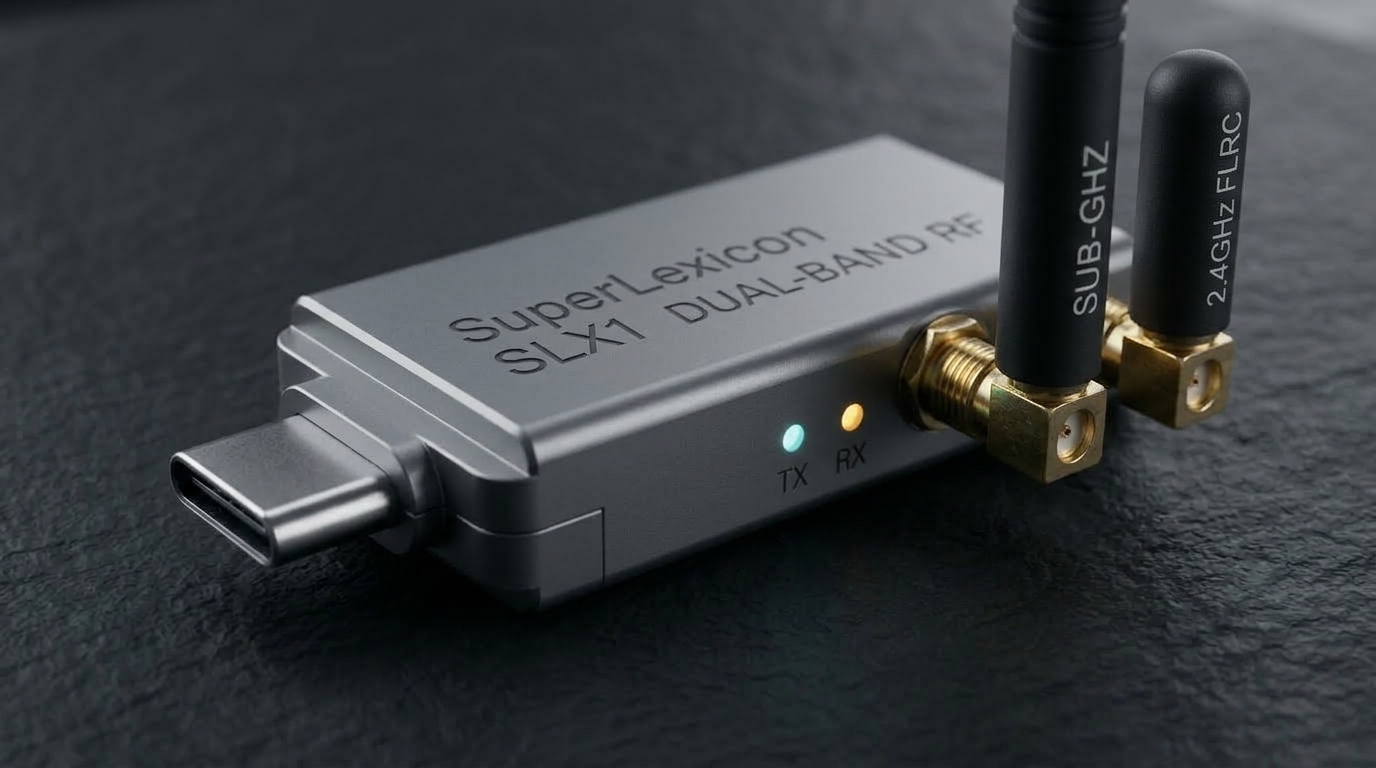
- Architecture: A compact CNC-machined anodized aluminum dongle enclosing a dual-band FLRC radio transceiver front-end and an embedded Nordic nRF54L15 microcontroller [42]. At the rear, dual gold-plated SMA connectors mount dedicated external antennas: a longer Sub-GHz whip antenna for long-range mesh propagation and a compact 2.4 GHz stub for high-rate consensus bursts.
- Operational Paradigm: Host-Tethered Radio Modem Peripheral. The SLX1 dedicates 100% of its internal silicon to RF modulation, carrier sensing, and framing, offloading blockchain state storage, transaction validation, and smart contract execution to a connected host device (laptop, desktop workstation, Raspberry Pi cluster, field vehicle computer, or tactical edge server) via high-speed USB-C (USB CDC ACM serial protocol [55]). The host machine runs full RocksDB state history [18] and executes contracts using either the Wasmtime AOT engine or the Embive interpreter.
- Target Scenarios: Humanitarian base stations, NGO coordination centers, emergency field clinics, and fixed tactical command posts where host computing power and mains electricity already exist.
2. SLX2: Dual-Mode E-Ink Pocket Companion (Ultra-Low-Power Field Terminal) #
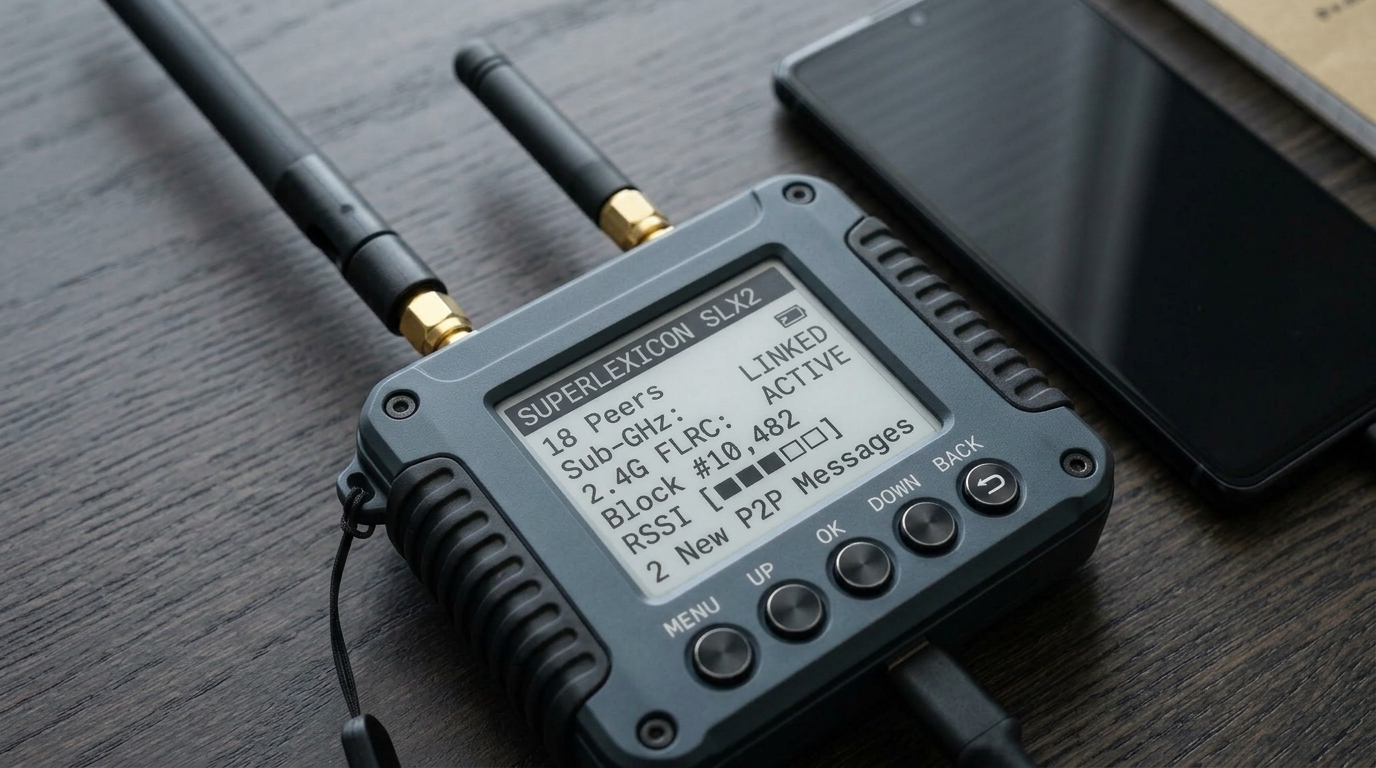
- Architecture: A lightweight, ruggedized pocket terminal featuring dual external antennas mounted on brass SMA couplings (a longer Sub-GHz whip and a compact 2.4 GHz stub), tactile navigation dials, a high-contrast sunlight-readable monochrome E-paper display, and an embedded low-power RISC-V microcontroller (such as a $160 - 400\ \text{MHz}$ 32-bit RV32 processor with $512\ \text{KB}$ internal SRAM and $4 - 8\ \text{MB}$ PSRAM).
- Autonomous Compute & Smart Contract Execution:
- Embedded Embive RV32I Engine: Natively executes compact 32-bit RISC-V smart contract binaries directly on the microcontroller. With the entire Embive engine requiring $< 20\ \text{KB}$ flash and $< 16\ \text{KB}$ RAM, contract bytecode ($400 - 1{,}000\ \text{bytes}$) fits easily into internal memory.
- Zero Network Latency Penalty & Execution Parity: On a $400\ \text{MHz}$ RISC-V core, executing a 32-transaction block takes approximately $1.6\ \text{ms}$ (compared to $\sim 0.4\ \text{ms}$ on an x86 laptop). Because the consensus engine’s Step 5 (
PreP3) allocates a $250 - 500\ \text{ms}$ compute airtime window, the SLX2 completes execution two orders of magnitude faster than the radio slot boundary—broadcasting votes and state roots with 100% timeliness and execution parity indistinguishable from an SLX3 or high-end laptop. - State-Pruned Verkle Root Validation: To operate within low-power flash limits, the SLX2 does not retain multi-gigabyte historical block archives. It functions as a state-pruned validator, maintaining only the current cryptographic Verkle/Merkle state root ($\text{Root}_h$) and the user's active accounts, verifying incoming transactions against cryptographic inclusion proofs in RAM.
- Optical Refresh Decoupling: The $100 - 300\ \text{ms}$ physical refresh cycle of the E-paper display is fully decoupled from the background BFT consensus engine; RF interrupts and cryptographic state transitions process in real time ($1 - 2\ \text{ms}$) without being stalled by the optical panel.
- Dual Operational Modes:
- Autonomous Sovereign Field Node: Independently validates live blocks, participates in BFT consensus rounds, verifies cryptographic proofs, monitors peer signal RSSI, and displays encrypted offline mesh messages with multi-week battery endurance on a single charge.
- Tethered Radio Modem: Connects via USB-C to smartphones or tablets, allowing mobile apps to leverage the SLX2's dual-band transceiver for off-grid payment settlement.
- Target Scenarios: Search-and-rescue personnel, disaster survivors in protracted grid blackouts, remote rangers, and unbanked rural communities with intermittent solar charging.
3. SLX3: Standalone Sovereign Communicator (Zero-Host Native Node) #
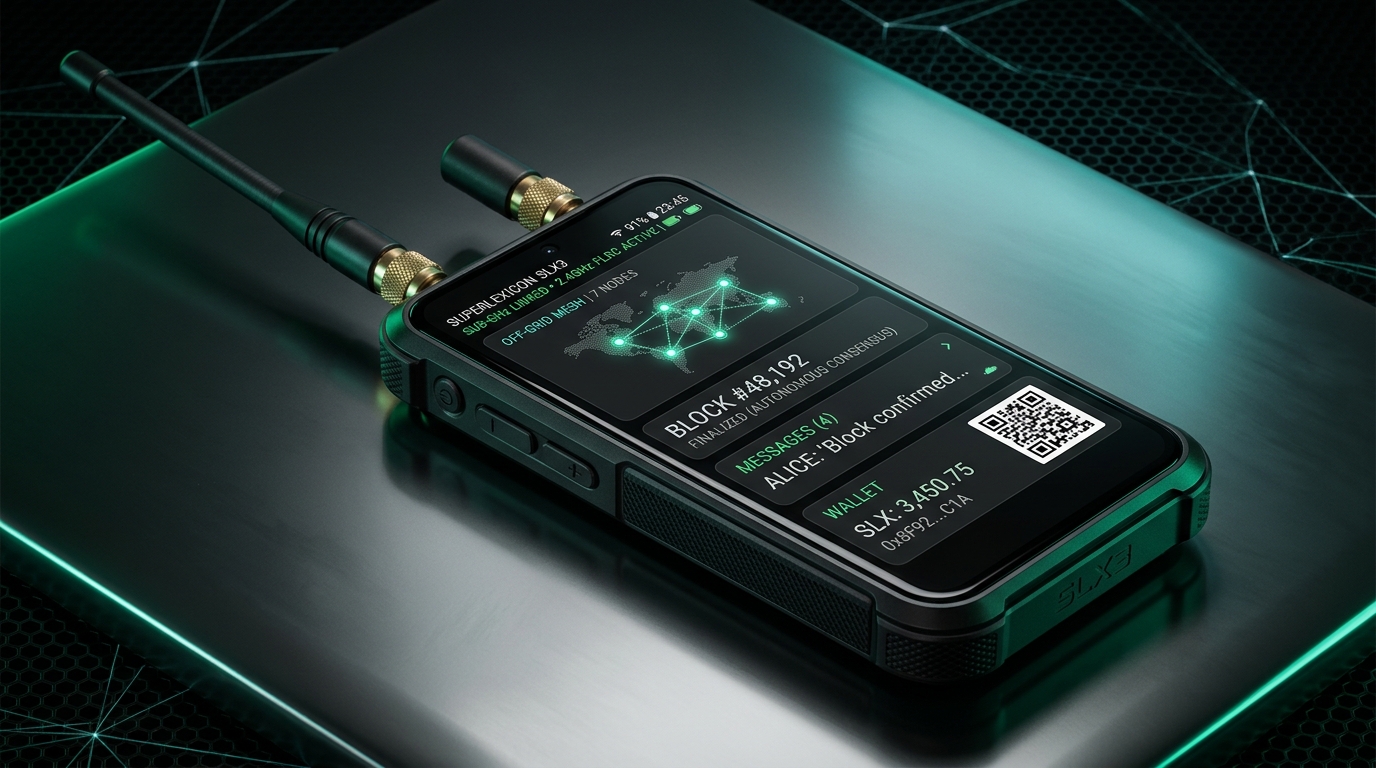
- Architecture: An all-in-one tactical handheld communicator powered by an embedded 64-bit multi-core application-class RISC-V processor (such as a Quad-Core RV64GC clocked at $1.5\ \text{GHz}$ with $2 - 4\ \text{GB}$ LPDDR4 RAM and $32 - 64\ \text{GB}$ high-speed storage). The top edge features dual knurled SMA antenna couplings for Sub-GHz and 2.4 GHz FLRC, fronted by an edge-to-edge full-color AMOLED touchscreen in an IP68 passively cooled aluminum chassis.
- Operational Paradigm: 100% Zero-Host Autonomy. Executes the entire SuperLexicon blockchain protocol natively without external computing hardware:
- Full Archival State: Houses local RocksDB state storage [18] maintaining complete historical block archives and transaction indexing.
- Dual Runtime Flexibility: Natively executes both Wasmtime AOT modules (via upstream
riscv64Cranelift compilation) and bare-metal Embive RISC-V contracts. - Direct Silicon Sandboxing via PMP: By leveraging physical RISC-V User Mode (
U-mode) and Physical Memory Protection (PMP), the SLX3 executes smart contracts directly on bare silicon with zero interpreter overhead. - Integrated Sovereign Suite: On-device tactical OS providing live mesh topology visualization, block finalization streams, end-to-end encrypted offline P2P messaging, and a sovereign wallet with instant zero-fee QR code settlement.
- Target Scenarios: Human rights defenders facing nationwide internet kill-switches [1], frontline disaster coordinators [54], and sovereign trade communities requiring total computational and telecommunication autonomy.
10. Comparative Analysis #
| Architectural Dimension | Traditional Blockchains (Ethereum / Solana) | Mesh Overlay Networks (Helium / Althea) | SuperLexicon Protocol |
|---|---|---|---|
| Underlying Physical Transport | Global TCP/IP, Fiber Optics, Data Centers | Internet-tethered gateways / LoRaWAN | Raw Radio PHY/MAC (FLRC / Sub-GHz) |
| Network Infrastructure Required | Routers, switches, ISPs, DNS, BGP | Cellular backhauls & cloud servers | Zero (No internet, no servers, no switches) |
| Networking Stack | Full TCP/IP & Socket layers | UDP / IP encapsulation | Bypasses TCP/IP completely (Raw SPI/UART CDC) |
| Consensus Topology | Multi-round unicast gossip ($O(N^2)$ streams) | Centralized coordinator / PoC beacons | P2MP Hardware Broadcast (1-to-many over RF) |
| Consensus Engine | Gasper / Tower BFT (Multi-round voting) | Off-chain state channels / HoneyBadger | Time-Slotted 4-Phase (8-Step) Single-Window |
| Smart Contract Sandbox | EVM (monolithic) / Sealevel (eBPF) | None (Token / payment channels only) | Wasmtime AOT (Testnet) + Embive RISC-V |
| Execution Performance | Gas-constrained, heavy JIT overhead | Off-chain execution only | Ultra-Fast Virtualized Software Execution (No HW Accel Needed) |
| Transaction / Gas Fees | Mandatory variable gas & priority fee auctions | Gateway transit fees & token bonding | Completely Free (Zero user fees; computational utility) |
| Spam & Sybil Control | Economic financialization (fee burning / tollbooths) | Balance staking & burn vouchers | Natural Physical Proximity Wall (Immunity to remote DDoS & Penetration) + Fair-Share Gas Allocation + Dynamic Probation |
| Global Scaling & Topography | Sharding / rollups bound to global sequencer | Static gateway mesh dependent on cloud | Autonomous Local Subnets + Dual-Modality Backhaul |
| Censorship Resilience | Vulnerable to IP blackouts & BGP hijacking | Gateway throttling & ISP controls | Physically Immune (Untraceable RF wave emission) |
10.1 The Mission-Critical Reliability Void: Why a Distributed BFT Quorum ACK Protocol is Mandatory #
A prevalent question in low-power wireless networking is why existing Low-Power Wide-Area Network (LPWAN) protocols—most prominently LoRaWAN [50]—cannot serve mission-critical operations such as tactical military command dissemination, emergency medical triage, or decentralized financial exchange order matching. Beyond physical bandwidth constraints, the fundamental barrier is architectural: the complete absence of fault tolerance and cryptographic proof-of-delivery over uncoordinated RF channels.
1. Why a Distributed BFT Quorum ACK Protocol Supercedes Conventional P2P and P2MP ACKs #
In mission-critical operating environments, sending a radio message cannot rely on unconfirmed fire-and-forget bursts or flawed acknowledgement paradigms. Conventional ACK protocols break down in half-duplex RF broadcast mediums:
- Conventional Unicast P2P ACKs ($O(N^2)$ Overhead): Point-to-point unicast handshakes (Node A $\rightarrow$ Node B, Node B $\rightarrow$ Node A ACK) scale quadratically with node count. In dense mesh networks, unicast ACK chatter rapidly saturates ISM duty-cycle caps (e.g., ETSI 1%) and causes exponential latency spikes.
- Manual / Uncoordinated P2MP ACKs (ALOHA Collisions): When a node broadcasts to multiple peers, having each receiving peer respond with an uncoordinated manual RF ACK frame triggers severe return-path ALOHA collisions, corrupting airtime and dropping ACK packets.
- SuperLexicon's Proof-of-Receipt (PoR) via Byzantine Quorum Acknowledgement (BQA): SuperLexicon replaces 1-to-1 P2P ACKs and colliding P2MP ACKs with a leaderless 4-phase BFT Virtual Token Ring. Validator nodes aggregate signatures directly on-air across scheduled unix-millisecond slots. Within a single timed consensus window, $> 2/3$ ($N - f$) of validators issue a unified Byzantine Quorum Certificate (
QC_Proof)—providing cryptographic Proof-of-Receipt (PoR) and atomic state agreement for all nodes simultaneously without RF collisions or retry storms.
2. Domain-Specific Mission-Critical Requirements #
- RF Stealth & SIGINT Geolocation (LPI/LPD): In contested Electronic Warfare (EW) theaters, conventional 1-to-1 P2P ACKs or uncoordinated P2MP ACK chatter expose units to enemy Direction-Finding (DF) and TDOA triangulation. Byzantine Quorum Acknowledgement (BQA) allows a stealth unit to transmit an order ONCE; local validators aggregate signatures in scheduled slots, allowing the originating unit to receive a unified
QC_Proofand revert to silent passive listening without firing repeated ACK request retries. - Tactical Military Order Execution: Military fire orders and maneuver commands require absolute execution certainty. A commander cannot tolerate waiting for unknown timeouts or guessing whether an order was silently jammed or executed.
- Search & Rescue / Emergency Medical Triage: Casualty triage classification and evacuation dispatching cannot wait for retry timeouts or polling cycles. Immediate Byzantine Quorum ACKs ensure all field units maintain identical, synchronized triage state.
- Off-Grid Financial CLOB Matching: Financial limit orders and cancellations sent over radio links require instant deterministic inclusion in the BFT ledger state, enabling fair, MEV-proof execution on the Discrete Time CLOB.
3. The Centralized Cloud Sequencer Dependency #
Because raw radio physical layers offer no proof of delivery or fault tolerance, traditional systems rely on a centralized star-of-stars topology:
When physical internet lines are cut or cellular towers fail in combat or natural disasters, delivery tracking and state sequencing collapse completely.
4. How SuperLexicon Guarantees BFT State Finality via Proof-of-Receipt (PoR) #
SuperLexicon transforms raw radio waves into a Byzantine Fault-Tolerant (BFT) State Engine with cryptographic Proof-of-Receipt (PoR) via Byzantine Quorum Acknowledgement (BQA):
- Multi-Party Quorum Certificate (
QC_Proof): Every mission-critical order (military command, financial order, or emergency dispatch) generates a BFT Quorum Certificate signed by $> 2/3$ of consensus nodes within a single consensus window, issuing instant cryptographic Proof-of-Receipt (PoR) over raw RF airwaves. - Byzantine Fault Tolerance ($f < N/3$): The state machine operates continuously even if up to one-third of radio nodes fail, are jammed, or act maliciously.
- Time-Slotted Collision-Free Token Ring: Unix-millisecond transmission slots eliminate ALOHA collisions, guaranteeing deterministic order delivery and ACK aggregation.
- On-Device Immutable Audit Trail: Executed orders commit an immutable receipt hash into the local RocksDB ledger on-device, establishing a tamper-proof execution record without cloud servers.
Through this architecture, SuperLexicon achieves what traditional LoRaWAN cannot: provable, decentralized, Byzantine-fault-tolerant Proof-of-Receipt (PoR) and strict order execution directly over raw radio waves—without internet backhaul, without cellular gateways, and without centralized cloud sequencers.
11. Conclusion #
SuperLexicon redefines the boundaries of decentralized physical infrastructure. By demonstrating that high-throughput, Byzantine fault-tolerant state machine replication can occur directly over low-power, half-duplex radio waves without the TCP/IP stack, servers, or switches, the protocol liberates digital ledgers from their physical vulnerabilities.
Through the synthesis of hardware-level Peer-to-Multiple-Peer broadcasting, an 8-step timed consensus window, autonomous local subnets, software-virtualized execution via Wasmtime and Embive, and multi-tiered non-monetary spam defense, SuperLexicon provides a resilient, infrastructure-free distributed state machine—ensuring deterministic ledger consensus even under severe connectivity outages.
12. Open Source Repositories & Implementation Architecture #
SuperLexicon is fundamentally committed to open-source systems engineering. The protocol stack spans bare-metal radio modem firmware, a high-performance Rust consensus daemon, decentralized identity infrastructure, and kernel-level hardware abstraction layer patches.
| Repository | Primary Language | Architectural Role & Scope | Access Status |
|---|---|---|---|
superlexicon/superlexicon | Rust | Core Protocol Monorepo: Verkle State Trie, 4-Phase Consensus Engine, Wasmtime & Embive VMs | Private Monorepo (Transitioning to Public) |
superlexicon/k230-lr2021-radio | C | K230 Bare-Metal LR2021 Blockchain Radio Driver & Hardware Abstraction Layer | Public / Open Source |
superlexicon/k230-device-ui | C / LVGL | K230 Sovereign Device UI Application & On-Device Handheld Wallet Interface | Public / Open Source |
superlexicon/flrc-firmware | C | nRF54L15 MCU Firmware: Dual-Band FLRC Radio Modem, Binary Framing, Dual-Antenna Fast Diversity | Public / Open Source |
superlexicon/ni6 | Rust / Python | Decentralized OSINT Server: Facial Proof-of-Life, Optical Document Analysis, SSS Social Recovery | Public / Open Source |
superlexicon/usp | C | Semtech USP HAL Fork: Exposes smtc_modem_hal_radio_irq_kick() to resolve edge-loss during RF retuning | Public Fork / Open Source |
12.1 Core Protocol Monorepo (superlexicon/superlexicon) #
- Repository:
github.com/superlexicon/superlexicon(Private monorepo; transitioning to public upon finalization of initial commit history) - Primary Language: Rust
- Architectural Scope:
- The deterministic time-slotted 4-phase (8-step) consensus engine and virtual token ring state machine.
- Pluggable
ExecutionBackendinterface featuring the active testnet Wasmtime AOT runtime and the bare-metal Embive RISC-V interpreter. - Fully replicated subnet Verkle state trie and RocksDB stage/commit pipeline.
- Zero-fee dynamic validator probation accounting and node fair-share gas allocation.
- Peer-to-Multiple-Peer (P2MP) raw radio framing, mention tabulation, and Byzantine quorum certificate validation.
12.2 Bare-Metal K230 LR2021 Radio Driver (superlexicon/k230-lr2021-radio) #
- Repository:
github.com/superlexicon/k230-lr2021-radio(Public / Open Source) - Primary Language: C / Bare-Metal Hardware Abstraction
- Target Hardware: Canaan Kendryte K230 Dual 64-bit RISC-V SoC + Semtech LR2021 Transceiver
- Architectural Scope:
- Bare-metal SPI driver and GPIO pin control interfacing the Canaan K230 RISC-V CPU directly with the Semtech LR2021 multi-band radio chip.
- Zero-overhead packet serialization, CRC computation, and direct register configuration for Sub-GHz and 2.4 GHz physical radio channels.
- Microsecond-level IRQ interrupt handling and hardware timer synchronization for off-grid consensus slot timing.
12.3 K230 Sovereign Device UI Application (superlexicon/k230-device-ui) #
- Repository:
github.com/superlexicon/k230-device-ui(Public / Open Source) - Primary Language: C / LVGL (Light and Versatile Graphics Library)
- Target Hardware: Canaan Kendryte K230 Handheld Platform with Color Display Subsystem
- Architectural Scope:
- Embedded sovereign handheld interface managing real-time consensus telemetry, validator state visualization, and encrypted offline message composition.
- Local hardware key management, zero-trust wallet transaction signing, and seed phrase recovery screens.
- High-performance frame buffer rendering optimized for handheld IPS/LCD panels paired with physical buttons or touch input.
12.4 Radio Modem & Fast Frequency-Hopping Firmware (superlexicon/flrc-firmware) #
- Repository:
github.com/superlexicon/flrc-firmware(Public / Open Source) - Primary Language: C
- Target Hardware: Nordic Semiconductor nRF54L15 Ultra-Low-Power MCU + Dual-Band FLRC Transceiver
- Architectural Scope:
- Binary framing interface (
MSG_CONFIG,MSG_READY,MSG_TX,MSG_RX,MSG_ERROR,MSG_STATS) over high-speed SPI CDC. - Fast Long Range Communication (FLRC) modulation control operating in the 2.4 GHz ISM band with 1.2 MHz bandwidth and 1.3 Mbps bitrates.
- Microsecond half-duplex transmit/receive switching discipline strictly locked to absolute Unix millisecond window boundaries.
- RF switch control for dual-antenna diversity and coordinated pseudorandom frequency hopping across consensus rounds.
12.5 Decentralized OSINT & Proof-of-Life Server (superlexicon/ni6) #
- Repository:
github.com/superlexicon/ni6(Public / Open Source) - Primary Language: Rust / Python / Machine Vision Pipeline
- Architectural Scope:
- The first decentralized open-source intelligence (OSINT) server engineered for zero-trust identity verification in off-grid and adversarial domains.
- Real-time proof-of-life and anti-spoofing facial biometric verification via localized video selfie processing.
- Cryptographic validation and automated optical analysis of sovereign identity documents (passports, national ID cards, tax registration certificates, bank statements).
- Decentralized social key recovery and multi-party escrow utilizing Shamir's Secret Sharing (SSS) [51] distributed across local subnet validator nodes.
12.6 Semtech HAL Driver & Edge-Triggering IRQ Patch (superlexicon/usp) #
- Repository:
github.com/superlexicon/usp(Public Fork / Open Source) - Primary Language: C
- Architectural Scope:
- Upstream fork of Semtech's Unified Software Platform (USP) Hardware Abstraction Layer.
- Declares and exposes
smtc_modem_hal_radio_irq_kick()within the official HAL interface. - Solves the critical physical edge-loss bug: when a level-held line with an edge-triggered pin loses transitions during radio modem frequency reconfiguration,
smtc_modem_hal_radio_irq_kick()safely re-injects the lost radio interrupt into the processing pipeline, preventing transaction stall cascades.
12.7 Open-Hardware Implementation Reference: LilyGO T-Display K230 (LR2021) #
To enable immediate community deployment and developer evaluation ahead of commercial hardware production, SuperLexicon officially maintains and targets the LilyGO T-Display K230 development platform (equipped with the Semtech LR2021 radio transceiver module) as the closest currently available open-hardware reference platform for the upcoming SLX3: Sovereign Communicator commercial handheld device.
- Dual 64-bit RISC-V SoC: Powered by Canaan's Kendryte K230 processor running at 1.6 GHz / 800 MHz, providing high-speed cryptographic signatures and local Verkle trie state verification.
- Integrated Radio Hardware: Coupled with Semtech's LR2021 multi-band radio chip via high-speed SPI, enabling dual Sub-GHz and 2.4 GHz FLRC consensus packet broadcast.
- Reference Software Compatibility: Runs the bare-metal
k230-lr2021-radiodriver stack alongside the LVGL-poweredk230-device-uiapplication, offering a fully functional standalone sovereign mesh handheld node without requiring custom silicon fabrication.
12.9 Protocol Codebase Anchors & Reference Implementation #
For researchers and contributors reviewing the reference implementation, the core modules map directly to the technical specifications outlined in this document:
- Consensus Window Clock & Step Dispatcher:
src/consensus/window.rs - Consensus Engine & Tracker Logic:
src/consensus/engine.rs - Wire Protocol & Consensus Messages:
src/consensus/messages.rsP2MPDisseminate, Phase 2SelectionVote, Phase 3ProposalCommit, and Phase 4FinalBlock. - Dual-Band FLRC Hardware Driver:
src/flrc_transport/radio.rs - Pluggable Transport Architecture:
src/transport/router.rs - Inter-Subnet Backhaul Gateway:
src/transport/backhaul.rs - Execution Backend & Multi-VM:
src/vm/backend.rs - Wasmtime AOT Runtime:
src/vm/wasm_executor.rs - Embive RISC-V Sandbox Runtime:
src/vm/embive_executor.rs - State Machine & Verkle Trie:
src/state/world_state.rs - Dynamic Governance & Validator Registry:
src/consensus/governance.rs
Appendices #
Appendix Appendix A: Academic & Technical References (Chicago Manual of Style) #
The following bibliography documents the theoretical foundations, cryptographic primitives, wireless propagation models, hardware specifications, and distributed consensus literature referenced throughout this specification, formatted in accordance with the Chicago Manual of Style (17th ed., Notes and Bibliography / Author-Date). Each entry explicitly identifies the protocol claims, hardware systems, or mathematical theorems it substantiates:
- [1] Access Now. 2024. "Shrinking Democracy, Growing Violence: Internet Shutdowns in 2023." KeepItOn Annual Report. New York: Access Now. https://www.accessnow.org/keepiton/.
Context: Supports §1.2, §9.4: State-directed telecommunications blackouts, BGP/DNS hijacking, and censorship resilience.
- [2] Antonakakis, Manos, Tim April, Michael Bailey, Matt Bernhard, Elie Bursztein, Jaime Cochran, Zakir Durumeric, et al. 2017. "Understanding the Mirai Botnet." In 26th USENIX Security Symposium (USENIX Security 17), 1093–1110. Vancouver, BC: USENIX Association. https://www.usenix.org/conference/usenixsecurity17/technical-sessions/presentation/antonakakis.
Context: Supports §1.3.1: Vulnerability of IP-exposed validator nodes to automated botnet DDoS and packet flood amplification.
- [3] Ardener, Shirley. 1964. "The Comparative Study of Rotating Credit Associations." The Journal of the Royal Anthropological Institute of Great Britain and Ireland 94 (2): 201–29. https://doi.org/10.2307/2844382.
Context: Supports §9.3: Sovereign micro-finance, community banking, and rotating savings and credit associations (ROSCAs) in off-grid regions.
- [4] Bellman, Richard. 1958. "On a Routing Problem." Quarterly of Applied Mathematics 16 (1): 87–90. https://doi.org/10.1090/qam/102435.
Context: Supports §5.4: Theoretical foundation of bounded distance-vector relaxation routing across multi-hop subnet meshes.
- [5] Benet, Juan. 2014. "IPFS - Content Addressed, Versioned P2P File System." arXiv preprint arXiv:1407.3561. https://doi.org/10.48550/arXiv.1407.3561.
Context: Supports §4.3: Content-addressed bytecode storage and hash-based code verification.
- [6] Bernstein, Daniel J., Niels Duif, Tanja Lange, Peter Schwabe, and Bo-Yin Yang. 2012. "High-Speed High-Security Signatures." Journal of Cryptographic Engineering 2 (2): 77–89. https://doi.org/10.1007/s13389-012-0027-1.
Context: Supports §1.3.2, §2.3, §3.2, Appendix B: Ed25519 high-speed elliptic curve digital signatures.
- [7] Bertsekas, Dimitri P., and Robert G. Gallager. 1992. Data Networks. 2nd ed. Upper Saddle River, NJ: Prentice Hall.
Context: Supports §1.3.2: Max-min fairness and node-level fair-share capacity partitioning across shared communication channels.
- [8] Buchman, Ethan, Jae Kwon, and Zarko Milosevic. 2018. "The Latest Gossip on BFT Consensus." arXiv preprint arXiv:1807.04938. https://doi.org/10.48550/arXiv.1807.04938.
Context: Supports §3.1: Tendermint Core BFT single-leader rotating consensus architecture.
- [9] Bünz, Benedikt, Lucianna Kiffer, Loi Luu, and Mahdi Zamani. 2020. "Flyclient: Super-Light Clients for Cryptocurrencies." In 2020 IEEE Symposium on Security and Privacy (SP), 928–46. San Francisco, CA: IEEE. https://doi.org/10.1109/SP40000.2020.00049.
Context: Supports §5.5: Cryptographic light-client state verification and cross-chain inclusion proofs.
- [10] Buterin, Vitalik, Eric Conner, Rick Dudley, Matthew Slipper, Ian Norden, and Abdelhamid Bakhta. 2021. "EIP-1559: Fee Market Change for ETH 1.0 Chain." Ethereum Improvement Proposals, no. 1559. https://eips.ethereum.org/EIPS/eip-1559.
Context: Supports §1.3: Monetary fee burning, priority tip auctions, and the distortions of monetary gas markets.
- [11] Buterin, Vitalik, and Virgil Griffith. 2017. "Casper the Friendly Finality Gadget." arXiv preprint arXiv:1710.09437. https://doi.org/10.48550/arXiv.1710.09437.
Context: Supports §3.1: Quorum finality gadgets and slashing conditions in proof-of-stake protocols.
- [12] Buterin, Vitalik, Diego Hernandez, Thor Kamphefner, Khiem Pham, Zhi Shen, Yan X., and Danny Ryan. 2020. "Combining GHOST and Casper: Combining Proof-of-Stake Consensus (Gasper)." arXiv preprint arXiv:2003.03052. https://doi.org/10.48550/arXiv.2003.03052.
Context: Supports Abstract, §3.1: Ethereum Gasper consensus architecture and multi-round attestation overhead.
- [13] Bytecode Alliance. 2024. "Wasmtime: A Fast and Secure Runtime for WebAssembly." Bytecode Alliance Documentation. https://wasmtime.dev/.
Context: Supports §6.2: Production testnet AOT WebAssembly execution engine with fuel metering.
- [14] Castro, Miguel, and Barbara Liskov. 2002. "Practical Byzantine Fault Tolerance and Proactive Recovery." ACM Transactions on Computer Systems (TOCS) 20 (4): 398–461. https://doi.org/10.1145/571637.571640.
Context: Supports Abstract, §1.3.2, §3.1, §7.1, Appendix B: Practical Byzantine Fault Tolerance (PBFT) and quorum consensus.
- [15] Cerf, Vinton, Scott Burleigh, Adrian Hooke, Leigh Torgerson, Richard Durst, Keith Scott, Kevin Fall, and Howard Weiss. 2007. "Delay-Tolerant Networking Architecture." RFC 4838, Internet Engineering Task Force (IETF). https://doi.org/10.17487/RFC4838.
Context: Supports Abstract, §5.4: Delay-Tolerant Networking (DTN) principles and store-and-forward relay topologies.
- [16] Collet, Yann, and Murray S. Kucherawy. 2021. "Zstandard Compression and the 'application/zstd' Media Type." RFC 8878, Internet Engineering Task Force (IETF). https://doi.org/10.17487/RFC8878.
Context: Supports §2.1, §2.3, Appendix C: High-speed Zstandard compression of wire payloads prior to RF modulation.
- [17] Daian, Philip, Steven Goldfeder, Tyler Kell, Yunqi Li, Xueyuan Zhao, Iddo Bentov, Lorenz Breidenbach, and Ari Juels. 2020. "Flash Boys 2.0: Frontrunning, Transaction Reordering, and Consensus Instability in Decentralized Exchanges." In 2020 IEEE Symposium on Security and Privacy (SP), 910–27. San Francisco, CA: IEEE. https://doi.org/10.1109/SP40000.2020.00040.
Context: Supports §1.3, §3.1: Maximal Extractable Value (MEV), priority gas auctions, and single-leader censorship.
- [18] Dingledine, Roger, Nick Mathewson, and Paul Syverson. 2004. "Tor: The Second-Generation Onion Router." In Proceedings of the 13th USENIX Security Symposium, 303–20. San Diego, CA: USENIX Association. https://www.usenix.org/conference/13th-usenix-security-symposium/tor-second-generation-onion-router.
Context: Supports §1.3.1: Inefficacy of remote IP proxying against physical RF proximity barriers.
- [19] Douceur, John R. 2002. "The Sybil Attack." In Peer-to-Peer Systems: First International Workshop (IPTPS 2002), edited by Peter Druschel, Frans Kaashoek, and Antony Rowstron, 251–60. Lecture Notes in Computer Science. Berlin, Heidelberg: Springer. https://doi.org/10.1007/3-540-45748-8_24.
Context: Supports §1.3, §1.3.2, §3.4: Sybil attack theory in decentralized systems without trusted central authorities.
- [20] Dwork, Cynthia, Nancy Lynch, and Larry Stockmeyer. 1988. "Consensus in the Presence of Partial Synchrony." Journal of the ACM (JACM) 35 (2): 288–323. https://doi.org/10.1145/42282.42283.
Context: Supports Abstract, §7.1, Appendix B: Consensus bounds in partially synchronous physical communication systems.
- [21] Evans, David S., and Richard Schmalensee. 2005. Paying with Plastic: The Digital Revolution in Buying and Borrowing. 2nd ed. Cambridge, MA: MIT Press.
Context: Supports §9.6: Economic analysis of retail point-of-sale card interchange fees and payment clearing latency.
- [22] Facebook Database Engineering Team. 2013. "RocksDB: A Persistent Key-Value Store for Fast Storage Environments." Meta Open Source. https://rocksdb.org/.
Context: Supports §4.1, §12.1, Appendix D: High-throughput embedded key-value storage engine for subnet state trie persistence.
- [23] Fischer, Michael J., Nancy A. Lynch, and Michael S. Paterson. 1985. "Impossibility of Distributed Consensus with One Faulty Process." Journal of the ACM (JACM) 32 (2): 374–82. https://doi.org/10.1145/3149.214121.
Context: Supports §7.1, Appendix B: The FLP impossibility result for deterministic asynchronous consensus.
- [24] Ford, Lester R., and Delbert R. Fulkerson. 1962. Flows in Networks. Princeton, NJ: Princeton University Press.
Context: Supports §5.4: Theoretical foundations of the distributed Ford-Fulkerson distance-vector routing algorithm.
- [25] Friis, Harald T. 1946. "A Note on a Simple Transmission Formula." Proceedings of the IRE 34 (5): 254–56. https://doi.org/10.1109/JRPROC.1946.234568.
Context: Supports §1.3.1: Friis free-space transmission equation and the inverse-square law ($P_r \propto 1/d^2$) governing RF proximity.
- [26] Gupta, Piyush, and P. R. Kumar. 2000. "The Capacity of Wireless Networks." IEEE Transactions on Information Theory 46 (2): 388–404. https://doi.org/10.1109/18.825799.
Context: Supports §2.4, §5.2: Mathematical proof that per-node throughput collapses as $O(1/\sqrt{n})$ in monolithic wireless broadcast meshes.
- [27] Haas, Andreas, Andreas Rossberg, Derek L. Schuff, Ben L. Titzer, Michael Holman, Dan Gohman, Luke Wagner, Alon Zakai, and JF Bastien. 2017. "Bringing the Web up to Speed with WebAssembly." In Proceedings of the 38th ACM SIGPLAN Conference on Programming Language Design and Implementation (PLDI 2017), 185–200. New York: ACM. https://doi.org/10.1145/3062341.3062363.
Context: Supports §6.2: The WebAssembly formal semantics, memory safety model, and deterministic execution sandbox.
- [28] Harris, Larry. 2003. Trading and Exchanges: Market Microstructure for Practitioners. Oxford: Oxford University Press.
Context: Supports §6.4: Central Limit Order Book (CLOB) FIFO price-time priority matching algorithms.
- [29] IEEE Standards Association. 2018. IEEE Standard for Smart Energy Profile Application Protocol: IEEE Std 2030.5-2018. Piscataway, NJ: IEEE. https://doi.org/10.1109/IEEESTD.2018.8608044.
Context: Supports §9.5: Machine-to-machine (M2M) autonomous device coordination and industrial microgrid balancing.
- [30] Jakes, William C., ed. 1974. Microwave Mobile Communications. New York: John Wiley & Sons.
Context: Supports §1.2, §2.5: Rayleigh multi-path fading, spatial antenna diversity, and mobile RF channel modeling.
- [31] Josefsson, Simon, and Ilari Liusvaara. 2017. "Edwards-Curve Digital Signature Algorithm (EdDSA)." RFC 8032, Internet Engineering Task Force (IETF). https://doi.org/10.17487/RFC8032.
Context: Supports §2.3, §3.2, Appendix B: Ed25519 digital signature parameters and binary wire encoding.
- [32] Kate, Aniket, Gregory M. Zaverucha, and Ian Goldberg. 2010. "Constant-Size Commitments to Polynomials and Their Applications." In Advances in Cryptology – ASIACRYPT 2010, edited by Masayuki Abe, 177–94. Lecture Notes in Computer Science. Berlin, Heidelberg: Springer. https://doi.org/10.1007/978-3-642-17373-8_11.
Context: Supports §4.1: KZG polynomial commitments enabling $O(1)$ constant-size vector proofs for Verkle state tries.
- [33] Kleinrock, Leonard. 1975. Queueing Systems, Volume II: Computer Applications. New York: John Wiley & Sons.
Context: Supports §2.4, §3.3: TDMA slot scheduling, queueing theory, and packet pacing disciplines in shared channels.
- [34] Kuszmaul, John. 2019. "Verkle Trees." Verkle Tree Specification / MIT PRIMES Research. Cambridge, MA: Massachusetts Institute of Technology. https://math.mit.edu/research/highschool/primes/materials/2018/Kuszmaul.pdf.
Context: Supports §4.1: Verkle tree state architecture replacing Merkle Patricia tries to minimize wireless frame witness sizes.
- [35] Lamport, Leslie. 1978. "Time, Clocks, and the Ordering of Events in a Distributed System." Communications of the ACM 21 (7): 558–65. https://doi.org/10.1145/359545.359563.
Context: Supports §3.1, §4.2: Logical clocks, total ordering of distributed transactions, and monotonic nonces.
- [36] Lamport, Leslie, Robert Shostak, and Marshall Pease. 1982. "The Byzantine Generals Problem." ACM Transactions on Programming Languages and Systems (TOPLAS) 4 (3): 382–401. https://doi.org/10.1145/357172.357176.
Context: Supports §1.3.2, §3.1, §7.1, Appendix B: The $N \ge 3f + 1$ resilience bound against Byzantine failures.
- [37] Lattner, Chris, and Vikram Adve. 2004. "LLVM: A Compilation Framework for Lifelong Program Analysis & Transformation." In Proceedings of the International Symposium on Code Generation and Optimization (CGO '04), 75–86. San Jose, CA: IEEE. https://doi.org/10.1109/CGO.2004.1281665.
Context: Supports §6.3: LLVM compiler toolchain targeting bare-metal 32-bit RISC-V ELF execution.
- [38] Malkin, Gary. 1998. "RIP Version 2." RFC 2453, Internet Engineering Task Force (IETF). https://doi.org/10.17487/RFC2453.
Context: Supports §5.4: Practical distance-vector metric relaxation, hop-limit bounding, and route expiration timers.
- [39] Mockapetris, Paul. 1987. "Domain Names - Concepts and Facilities." RFC 1034, Internet Engineering Task Force (IETF). https://doi.org/10.17487/RFC1034.
Context: Supports §1.1, §1.3.1: Centralized Domain Name System (DNS) infrastructure risks and censorship chokepoints.
- [40] Nakamoto, Satoshi. 2008. "Bitcoin: A Peer-to-Peer Electronic Cash System." Decentralized Business Review, 21260. https://bitcoin.org/bitcoin.pdf.
Context: Supports §1.1: Foundational peer-to-peer electronic cash architecture and Proof-of-Work blockchain design.
- [41] National Institute of Standards and Technology (NIST). 2015. SHA-3 Standard: Permutation-Based Hash and Extendable-Output Functions. Federal Information Processing Standards Publication (FIPS PUB) 202. Washington, D.C.: U.S. Department of Commerce. https://doi.org/10.6028/NIST.FIPS.202.
Context: Supports §2.3, §3.2, Appendix B: Keccak-256 and SHA3-256 cryptographic hashing standards.
- [42] Nordic Semiconductor. 2024. nRF54L15 Ultra-Low Power Bluetooth 5.4, 2.4 GHz Proprietary, and Matter System-on-Chip: Product Specification v1.0. Trondheim, Norway: Nordic Semiconductor ASA.
Context: Supports §1.3.2, §2.1, §12.2: Architecture and specifications of the dedicated ultra-low-power radio microcontroller.
- [43] Ongaro, Diego, and John Ousterhout. 2014. "In Search of an Understandable Consensus Algorithm." In 2014 USENIX Annual Technical Conference (USENIX ATC 14), 305–19. Philadelphia, PA: USENIX Association. https://www.usenix.org/conference/atc14/technical-sessions/presentation/ongaro.
Context: Supports §3.1: Raft single-leader state machine replication and view-change leader election dynamics.
- [44] O'Neil, Patrick, Edward O'Neil, and Gerhard Weikum. 1996. "The Log-Structured Merge-Tree (LSM-Tree)." Acta Informatica 33 (4): 351–85. https://doi.org/10.1007/s002360050048.
Context: Supports §4.1: Log-Structured Merge-Tree architectural foundation of RocksDB embedded persistent storage.
- [45] Paulraj, Arogyaswami J., Dhananjay A. Gore, Rohit U. Nabar, and Helmut Bölcskei. 2004. "An Overview of MIMO Communications: A Key to Gigabit Wireless." Proceedings of the IEEE 92 (2): 198–218. https://doi.org/10.1109/JPROC.2003.821915.
Context: Supports §2.5: Multi-antenna simultaneous broadcasting, beamforming, and spatial diversity in wireless channels.
- [46] Postel, Jon. 1980. "User Datagram Protocol." RFC 768, Internet Engineering Task Force (IETF). https://doi.org/10.17487/RFC768.
Context: Supports §5.4: User Datagram Protocol (UDP) asynchronous packet transport for inter-subnet broadband backhauls.
- [47] Postel, Jon. 1981. "Transmission Control Protocol." RFC 793, Internet Engineering Task Force (IETF). https://doi.org/10.17487/RFC793.
Context: Supports §1.1, §5.4: Traditional TCP unicast streaming overhead and connection-oriented backhauls.
- [48] Protocol Labs. 2020. libp2p: A Modular Network Stack. Protocol Labs Specification Repository. https://github.com/libp2p/specs.
Context: Supports §1.1, §4.3: Point-to-point stream gossip libraries and out-of-band smart contract bytecode synchronization.
- [49] Rekhter, Yakov, Tony Li, and Susan Hares, eds. 2006. "A Border Gateway Protocol 4 (BGP-4)." RFC 4271, Internet Engineering Task Force (IETF). https://doi.org/10.17487/RFC4271.
Context: Supports §1.1, §9.4: Border Gateway Protocol (BGP) routing hierarchies, transit bottlenecks, and ISP route hijacking.
- [50] Semtech Corporation. 2023. Dual-Band Sub-GHz and 2.4 GHz Multi-Protocol FLRC Transceiver Technical Specification and Physical Layer Architecture. Camarillo, CA.
Context: Supports Abstract, §2.1, §2.2, §8.1, Appendix C: Physical radio transceiver hardware specifications and FLRC modem registers.
- [51] Shamir, Adi. 1979. "How to Share a Secret." Communications of the ACM 22 (11): 612–13. https://doi.org/10.1145/359168.359176.
Context: Supports §12.3: Shamir's Secret Sharing (SSS) for decentralized identity escrow and threshold key recovery.
- [52] The Zephyr Project. 2024. Zephyr RTOS: An Open Source Embedded Real-Time Operating System. San Francisco, CA: The Linux Foundation. https://www.zephyrproject.org/.
Context: Supports §2.1, §12.5: Real-time embedded operating system executing edge-triggered radio modem HAL drivers.
- [53] Torrieri, Don. 2018. Principles of Spread-Spectrum Communication Systems. 4th ed. Cham, Switzerland: Springer International Publishing. https://doi.org/10.1007/978-3-319-70569-9.
Context: Supports §1.2, §2.5, §9.2: Coordinated Frequency-Hopping Spread Spectrum (FHSS) anti-jamming techniques in wireless networks.
- [54] United Nations Office for the Coordination of Humanitarian Affairs (UN OCHA). 2021. Disaster Response and Telecommunications Resilience in Natural Emergencies. Geneva: United Nations.
Context: Supports §9.1: Emergency off-grid communications and cryptographic ration distribution during infrastructure collapse.
- [55] USB Implementers Forum. 2010. Universal Serial Bus Class Definitions for Communication Devices, Version 1.2. Beaverton, OR: USB-IF.
Context: Supports §2.1, §2.2: USB CDC ACM raw serial framing interface between host processor and radio MCU.
- [56] Waterman, Andrew, and Krste Asanović, eds. 2019. The RISC-V Instruction Set Manual, Volume I: User-Level ISA, Document Version 2.2. Berkeley, CA: RISC-V Foundation.
Context: Supports Abstract, §6.3: Standard RISC-V RV32I user-level instruction set architecture for embedded smart contracts.
- [57] Wood, Gavin. 2014. "Ethereum: A Secure Decentralised Generalised Transaction Ledger." Ethereum Project Yellow Paper 151: 1–32.
Context: Supports §1.1, §4.1, §4.2, §5.5: World state transition models, account nonces, RLP encoding, and Merkle Patricia tries.
- [58] Yakovenko, Anatoly. 2018. "Solana: A New Architecture for a High Performance Blockchain v0.8.13." Whitepaper. https://solana.com/solana-whitepaper.pdf.
Context: Supports Abstract, §3.1: Solana Tower BFT single-leader consensus architecture and Proof of History.
- [59] Yin, Maofan, Dahlia Malkhi, Michael K. Reiter, Guy Golan Gueta, and Ittai Abraham. 2019. "HotStuff: BFT Consensus with Linearity and Responsiveness." In Proceedings of the 2019 ACM Symposium on Principles of Distributed Computing (PODC '19), 347–56. Toronto, ON: ACM. https://doi.org/10.1145/3293611.3331591.
Context: Supports §3.1: HotStuff pipelined leader-driven BFT consensus architecture.
- [60] Bravo-Arrabal, Juan, Pablo Zambrana, Javier J. Fernández-Lozano, and Jaime Gomez-de-Gabriel. 2022. "Realistic Deployment of Hybrid Wireless Sensor Networks Based on ZigBee and LoRa for Search and Rescue Applications." IEEE Access 10: 64234–64246. https://doi.org/10.1109/ACCESS.2022.3183135.
Context: Supports §9.1: Field deployments of LoRa telemetry in disaster search-and-rescue and operational limits under uncoordinated contention.
- [61] Sravan, S. S., Susmita Mandal, and P. J. A. Alphonse. 2024. "LIO-PAY: Sustainable Low-Cost Offline Payment Solution." Electronic Commerce Research and Applications 64: 101440. https://doi.org/10.1016/j.elerap.2024.101440.
Context: Supports §9.3: Offline peer-to-peer LoRa payment mechanisms and the requirement for decentralized ledger double-spend prevention.
- [62] Sidorov, Michail, Jing Huey Khor, and Phan Viet Nhut. 2020. "A Public Blockchain-Enabled Wireless LoRa Sensor Node for Continuous Unattended Health Monitoring." IEEE Sensors Journal 20 (22): 13769–13777. https://doi.org/10.1109/JSEN.2020.3001870.
Context: Supports §9.4, §9.5: LoRa remote sensor data logging architectures and vulnerabilities to centralized gateway severance.
- [63] Souli, Nicolas, Maria Karatzia, Christos Georgiades, Panayiotis Kolios, and Georgios Ellinas. 2024. "Mission-Critical UAV Swarm Coordination and Cooperative Positioning Using an Integrated ROS-LoRa-Based Communications Architecture." Computer Communications 226: 1–13. https://doi.org/10.1016/j.comcom.2024.07.011.
Context: Supports §9.5: ROS-integrated LoRa robotic swarm communications, channel saturation, and latency bottlenecks under uncoordinated access.
- [64] Zhou, Weiwei, Ziyuan Tong, and Zhao Yang Dong. 2019. "LoRa-Hybrid: A LoRaWAN Based Multihop Solution for Regional Microgrid." In 2019 IEEE 4th International Conference on Computer and Communication Systems (ICCCS), 663–668. https://doi.org/10.1109/CCOMS.2019.8821683.
Context: Supports §9.5: Microgrid smart metering telemetry over LoRa and centralized coordinator failure modes.
Appendix Appendix B: Formal Consensus Theorems & Byzantine Fault Tolerance Proofs #
To establish the mathematical correctness, safety invariants, and liveness properties of SuperLexicon over half-duplex wireless networks, we formalize the protocol state machine under the Byzantine failure model.
B.1 System Model & Physical Network Assumptions #
- Validator Registry: Let $\mathcal{V} = \{V_1, V_2, \dots, V_N\}$ denote the static active validator set at block height $h$. The maximum number of Byzantine (arbitrarily malicious, equivocating, or silent) nodes is $f$, satisfying the classical Byzantine bound $N \ge 3f + 1$.
- Clock Discipline & Slot Alignment: Every validator possesses a hardware Real-Time Clock (RTC) with maximum mutual drift bounded by $\Delta_{\text{drift}} \le 15\ \text{ms}$. Consensus rounds occur in discretized wall-clock windows $W_i = \lfloor t_{\text{unix\_ms}} / T_{\text{window}} \rfloor$. All state machine step transitions are strictly clock-driven.
- Half-Duplex Broadcast Medium with Bernoulli Loss: The shared RF spectrum operates under half-duplex constraints: a node cannot transmit and receive simultaneously on the same channel. Outbound transmissions within an assigned TDMA slot are received by an honest listening peer with probability $1 - p_{\text{loss}}$, where $p_{\text{loss}} \in [0, 1)$ accounts for independent channel fading, path loss, and ambient noise. Physical air propagation delay satisfies $\Delta_{\text{prop}} \le 5\ \mu\text{s}$ over tactical operating radii ($\le 1.5\ \text{km}$), which is negligible relative to slot durations.
- Cryptographic Primitives: Digital signatures generated via Ed25519 [6], [31] are existentially unforgeable under chosen-message attacks (EUF-CMA). Cryptographic digests generated via Keccak-256 and SHA3-256 [41] satisfy collision resistance and preimage resistance.
B.2 Quorum Intersection Invariant #
Let $\mathcal{Q}$ denote the family of valid Byzantine quorum certificates. A block proposal is officially finalized if and only if it accumulates a certificate formed by signatures from a quorum $Q \subset \mathcal{V}$ satisfying:
Lemma 1 (Quorum Intersection in Wireless Broadcasts): Any two valid quorums $Q_A, Q_B \in \mathcal{Q}$ intersect in at least one honest validator.
Proof:
By standard set theory:
| Since $Q_A, Q_B \subseteq \mathcal{V}$, their union cannot exceed the total validator fleet: $ | Q_A \cup Q_B | \le N$. Substituting the quorum threshold $ | Q | \ge N - f$: |
|---|
Applying the Byzantine bound $N \ge 3f + 1$:
Because the total number of Byzantine nodes in $\mathcal{V}$ is at most $f$, the pigeonhole principle guarantees that at least:
validator in the intersection $Q_A \cap Q_B$ is strictly honest. $\blacksquare$
Formal Theorem B.3 Rigorous Proof of Theorem 1 (Safety Guarantee Across Rounds) #
Under the 4-phase consensus engine, two honest validators $V_1$ and $V_2$ cannot finalize different blocks at height $h$.
Proof:
Let $\mathcal{K} = (\text{ParentHash}, \text{set\_root}, \text{post\_state\_root})$ represent the unique execution commitment tuple.
Assume for contradiction that validator $V_1$ finalizes commitment $\mathcal{K}_A$ and validator $V_2$ finalizes commitment $\mathcal{K}_B$ at height $h$, with $\mathcal{K}_A \neq \mathcal{K}_B$.
| 1. By the definition of finality in Phase 4, validator $V_1$ finalized $\mathcal{K}_A$ because it received valid, signed Phase 3 proposals from a quorum $Q_A \subset \mathcal{V}$ with $ | Q_A | \ge N - f$, each committing to $\mathcal{K}_A$. |
|---|---|---|
| 2. Similarly, validator $V_2$ finalized $\mathcal{K}_B$ because it received valid, signed Phase 3 proposals from a quorum $Q_B \subset \mathcal{V}$ with $ | Q_B | \ge N - f$, each committing to $\mathcal{K}_B$. |
- By Lemma 1, the intersection $Q_A \cap Q_B$ contains at least $f + 1$ validators, of which at least one, denoted $V_{\text{honest}}$, is honest.
- For $V_{\text{honest}} \in Q_A$, $V_{\text{honest}}$ must have emitted a signed proposal committing to $\mathcal{K}_A$.
- For $V_{\text{honest}} \in Q_B$, $V_{\text{honest}}$ must have emitted a signed proposal committing to $\mathcal{K}_B$.
- According to the deterministic 8-step consensus state machine:
- Step 5 (
PreP3) executes exactly once per wall-clock window $W_i$. - The signing routine
sign_proposal()verifies that the internal monotonic sequenceproposal_seqequals $h$. - Once signed,
proposal_seqincrements to $h+1$, preventing subsequent signatures at height $h$. - An honest validator never signs two distinct preimages for the same height $h$.
- Signing both $\mathcal{K}_A$ and $\mathcal{K}_B$ where $\mathcal{K}_A \neq \mathcal{K}_B$ constitutes verifiable cryptographic equivocation. Since $V_{\text{honest}}$ is honest by construction, it cannot equivocate.
- Therefore, the intersection cannot contain an honest validator that signed conflicting proposals, contradicting Lemma 1.
We conclude that $\mathcal{K}_A = \mathcal{K}_B$. Conflicting finalization at height $h$ is mathematically impossible. $\blacksquare$
Formal Theorem B.4 Rigorous Proof of Theorem 2 (Liveness & Uncoordinated Clean Reset) #
If an RF transmission window $W_i$ suffers packet loss such that no group achieves $N - f$ matching proposals, the network cleanly transitions to window $W_{i+1}$ without state deadlocks, and terminates with probability $1$ as $k \to \infty$ whenever an unjammed window occurs.
Proof:
- Absence of Blocking Primitives: The consensus engine contains zero blocking socket operations, interactive handshakes, or lock-dependent transitions. All step advances occur strictly on wall-clock time boundaries:
- Deterministic Cleanup Invariant: At $t = T_{\text{window}}$, Step 8 (
PreP1of $W_{i+1}$) executes across all validators:
- If the proposal tally in Step 7 did not reach the quorum threshold $N - f$, the uncommitted state diff in memory is purged.
- Verified transactions remain in the replicated mempool.
- The block height remains at $h$.
- No view-change or leader-election rounds are initiated.
- Probabilistic Termination: Let $p_{\text{succ}}$ denote the joint probability that at least $N - f$ honest nodes successfully receive each other's Phase 1, Phase 2, and Phase 3 air frames in window $W_{i+k}$. Under independent channel fading:
The probability that consensus fails to finalize after $K$ consecutive windows is:
Since $0 < 1 - p_{\text{succ}} < 1$:
Therefore, the protocol finalizes height $h$ with probability $1$ in finite time. $\blacksquare$
Appendix Appendix C: SLRF Hardware Wire Protocol & Frame Layout Anatomy #
The SuperLexicon Radio Frequency (SLRF) binary framing standard operates directly atop the physical radio transceiver without network or transport layer encapsulation.
C.1 Over-The-Air Binary Frame Layout #
 0                   1                   2                   3
 0 1 2 3 4 5 6 7 8 9 0 1 2 3 4 5 6 7 8 9 0 1 2 3 4 5 6 7 8 9 0 1
+-+-+-+-+-+-+-+-+-+-+-+-+-+-+-+-+-+-+-+-+-+-+-+-+-+-+-+-+-+-+-+-+
|       Physical Preamble (16 - 32 Bits, Transceiver Hardware) |
+-+-+-+-+-+-+-+-+-+-+-+-+-+-+-+-+-+-+-+-+-+-+-+-+-+-+-+-+-+-+-+-+
|     RF Sync Word: 0x534C2021 ("SL !" Semtech Hardware Match)   |
+-+-+-+-+-+-+-+-+-+-+-+-+-+-+-+-+-+-+-+-+-+-+-+-+-+-+-+-+-+-+-+-+
|             SLRF Magic Prefix: 0x53 0x4C 0x52 0x46            |
|                           ("SLRF")                            |
+-+-+-+-+-+-+-+-+-+-+-+-+-+-+-+-+-+-+-+-+-+-+-+-+-+-+-+-+-+-+-+-+
| Proto Ver: 0x0101 ("\x01\x01")| Subnet Tag: 0x5F76 ("_v")     |
+-+-+-+-+-+-+-+-+-+-+-+-+-+-+-+-+-+-+-+-+-+-+-+-+-+-+-+-+-+-+-+-+
| Msg Type (1B) | Flags (1B)    |       Payload Length (16B)    |
+-+-+-+-+-+-+-+-+-+-+-+-+-+-+-+-+-+-+-+-+-+-+-+-+-+-+-+-+-+-+-+-+
|                                                               |
|             Zstandard-Compressed Payload Body                 |
|             (Bincode-Serialized Consensus Structure)          |
|                                                               |
+-+-+-+-+-+-+-+-+-+-+-+-+-+-+-+-+-+-+-+-+-+-+-+-+-+-+-+-+-+-+-+-+
|                CRC-32-IEEE / Hardware Checksum                |
+-+-+-+-+-+-+-+-+-+-+-+-+-+-+-+-+-+-+-+-+-+-+-+-+-+-+-+-+-+-+-+-+
C.2 Physical Modulation Parameters (Dual-Band FLRC Radio) #
| Parameter | Value | Architectural Justification |
|---|---|---|
| Modulation Mode | FLRC (Fast Long Range Communication) | Optimal balance of bit-rate ($1.3\ ext{Mbps}$) and multi-path resilience |
| Frequency Band | $2400.0 - 2483.5\ ext{MHz}$ (ISM Band) | Globally unlicensed, high data capacity for local subnets |
| Channel Bandwidth | $1.2\ ext{MHz}$ | Maximizes receiver sensitivity while accommodating high-speed burst packets |
| Coding Rate | $1/2$ or $3/4$ Convolutional Coding | Robust Forward Error Correction (FEC) against transient burst noise |
| Transmit Output Power | $+13\ ext{dBm}$ to $+22\ ext{dBm}$ | Software-selectable; $16\ ext{mW}$ to $158\ ext{mW}$ for portable battery nodes |
| Receiver Sensitivity | $-108\ ext{dBm}$ to $-115\ ext{dBm}$ | Ensures reliable link budget across $>500\ ext{m}$ urban / $>2\ ext{km}$ rural LOS |
| Interframe Turnaround | $\ge 1200\ \mu ext{s}$ | Allows PLL retuning and MCU SPI buffer clearing between half-duplex bursts |
Appendix Appendix D: Protocol Source Code Anchors & Reference Implementation #
The SuperLexicon reference implementation is organized across specialized modules within the core Rust workspace and companion firmware repositories:
| Subsystem | Source Path | Core Functionality & Invariants |
|---|---|---|
| Consensus Window Engine | src/consensus/window.rs | Governs absolute Unix-ms slot pacing, hold-to-boundary transitions, and the 8-step dispatch loop. |
| Consensus State Machine | src/consensus/engine.rs | Enforces virtual token ring voting, mention elections, and quorum certificate aggregation. |
| Subnet Routing & Discovery | src/consensus/subnet.rs | Subnet distance-vector routing table, SubnetAdvertisement, SubnetRoutedTxn, and SubnetRoutedBlock envelopes. |
| Wire Protocol Messages | src/consensus/messages.rs | Binary serializations for Phase 1 P2MPDisseminate, Phase 2 SelectionVote, Phase 3 ProposalCommit, and Phase 4 FinalBlock. |
| Hardware Radio Driver | src/flrc_transport/radio.rs | Host SPI interface handling binary command frames to the nRF54L15 MCU; enforces chunk caps ($\le 500 ext{B} / \le 600 ext{B}$). |
| Pluggable Router | src/transport/router.rs | Decouples physical radio packets from virtual loopback and simulated mesh transports. |
| Inter-Subnet Backhaul Gateway | src/transport/backhaul.rs | Bridges state between local radio subnets via broadband IP or RF daisychains. |
| Execution VM Interface | src/vm/backend.rs | Unified trait defining zero-fee state transition execution across sandboxes. |
| Wasmtime AOT Runtime | src/vm/wasm_executor.rs | Active testnet software-virtualized execution engine with deterministic fuel metering. |
| Embive RISC-V Runtime | src/vm/embive_executor.rs | Bare-metal RV32I interpreter for constrained edge environments and microcontrollers. |
| Verkle State & Storage | src/state/world_state.rs | Deterministic sequential state transition management and RocksDB storage engine. |
| Governance & Probation | src/consensus/governance.rs | Dynamic probation tracking, candidate promotion streaks, and fair-share gas allocation. |